pharma supply chain Archives - Page 6 of 9 - rfxcel.com
Rfxcel Logo

Mobilogix and rfxcel Announce Strategic Partnership in IoT Solutions

Irvine, Calif., Oct. 13, 2021 (PRNewswire). Mobilogix, the leading provider of cost-optimized state-of-the-art cellular IoT solutions, today announced a strategic partnership with rfxcel, part of Antares Vision Group and a leading serialization and traceability enterprise solution provider. Together, the companies will offer innovative supply chain and logistics IoT solutions that complement each other’s strengths to greater serve growing market demands, including asset tracking and traceability for full end-to-end supply chain visibility.

Mobilogix will support rfxcel with an array of its solutions, including the BAT-X IoT tracker and BTM250 Bluetooth beacon sensor. rfxcel’s track and trace software solutions meet the growing demand for smart, scalable asset-tracking optimized for logistics and supply chain use cases. “It is a critical time to serve the market’s growing needs,” said Charlie Williams, EVP Sales and Marketing at Mobilogix. “We are pleased to leverage our synergies to penetrate the market for both partners.”

“We are excited about partnering with Mobilogix to provide track and trace solutions that utilize the latest and best IoT technologies,” said rfxcel CEO Glenn Abood. “By combining Mobilogix’s innovative hardware with our best-in-class track and trace software, we offer better data and operational outcomes for any market and any industry.”

For more information about rfxcel and the Mobilogix partnership, contact rfxcel Vice President of Marketing and Strategic Initiatives Herb Wong at 925-791-3235 or hwong@rfxcel.com.

About Mobilogix

Mobilogix is the world’s leading provider in IoT asset optimization and management solutions. The company’s solutions are deployed by leading companies in Agriculture, Automotive, Construction, Industrial and Transportation to track, monitor, and optimize their assets with actionable real-time data. Mobilogix is headquartered in Irvine, California, and has global offices in BrazilIndiaHong Kong and China. For more information, please call +1.949.748.8895, e-mail info@mobilogix.com.

About rfxcel

Part of Antares Vision Group, rfxcel provides leading-edge software solutions to help companies build and manage their digital supply chain, lower costs, protect their products and brand reputations, and engage consumers. Blue-chip organizations in the life sciences (pharmaceuticals and medical devices), food and beverage, worldwide government, and consumer goods industries trust rfxcel’s Traceability System to power end-to-end supply chain solutions in track and trace, environmental monitoring, regulatory compliance, serialization, and visibility. Founded in 2003, the company is headquartered in the United States and has offices in the United Kingdom, the EU, Latin AmericaRussiaIndiaJapan, the Middle East, and the Asia-Pacific region.

About Antares Vision Group

Antares Vision Group protects products, people, and brands with inspection systems featuring 6,500 quality controls, track and trace software solutions for end-to-end transparency and visibility in digital supply chains, and smart data management tools for maximum operational efficiency, from raw materials to final consumers. It provides solutions to five primary industries: pharmaceuticals and life sciences (medical devices and hospitals), food and beverage, cosmetics, and consumer packaged goods. Active in more than 60 countries, Antares Vision Group has seven production facilities and three Innovation and Research Centers in Italy, 22 foreign subsidiaries, and a global network of more than 40 partners. Today, 10 of the world’s 20 leading pharmaceutical companies use its solutions to secure their production and supply chain operations; worldwide, it has deployed more than 25,000 inspection systems and more than 3,500 serialization modules. Antares Vision Group has been listed on the Italian Stock Exchange’s AIM Italia market since April 2019 and in the STAR Segment of the Mercato Telematico Azionario (MTA) since May 2021.

rfxcel, Part of Antares Vision Group, and MVC Sign Agreement with Lebanese Republic to Deploy End-to-End Pharmaceutical Traceability Hub

The agreement continues the partners’ success in the Middle East, where they recently launched the first GS1-compliant Traceability Hub in the Kingdom of Bahrain.

Reno, Nevada, Sept. 22, 2021 (EINPRESSWIRE). rfxcel, part of Antares Vision Group and a global leader in digital supply chain traceability solutions, today announced that it signed a five-year cooperative agreement with the Lebanese Republic’s Ministry of Public Health to provide a GS1-compliant Traceability Hub to secure the country’s entire pharmaceutical supply chain. The company will implement the system with its partner Medical Value Chain (MVC), the Bahrain subsidiary of U.S.-based AVC Global.

The announcement comes only a few months after rfxcel and MVC were selected by Bahrain’s National Health Regulatory Authority and Supreme Council of Health to provide the first GS1-compliant system to track the Kingdom’s entire pharmaceutical supply chain on a blockchain platform.

The Lebanon Traceability Hub will deliver end-to-end visibility into every aspect of the country’s pharmaceutical supply chain, from the manufacturer of origin, importers, wholesalers, and distributors to pharmacies, clinics, and hospitals — all the way to individual patients. It will integrate with the Ministry of Public Health’s MediTrack system for domestic manufacturers.

The Hub is designed to achieve the following:

  • Lower the cost of pharmaceuticals
  • Provide patients with only authentic, safe medications
  • Combat drug counterfeiting and smuggling
  • Ensure access to pharmaceuticals subsidized by the Banque du Liban, the central bank of Lebanon
  • Prevent hoarding of medicines

“The Hub is all about leveraging leading-edge technology to secure Lebanon’s pharmaceutical supply chain and safeguard patients and consumers,” rfxcel CEO Glenn Abood said. “Security and safety — these are the very reasons I founded rfxcel almost 20 years ago. We’re eager to begin our work with MVC in Lebanon, and we’ll continue to focus on bringing Traceability Hubs to other countries in the Middle East and beyond.”

MVC Co-Founder and President Leo Giacometto said, “The MVC technology platform with blockchain revolutionizes the delivery and integrity of pharmaceutical supply chains in Lebanon. We are excited and honored to deploy our platform in partnership with the Ministry of Public Health in the Republic of Lebanon.”

Emidio Zorzella, Antares Vision Group CEO, said, “We’re all eager to start working with the Ministry of Public Health and gratified that everything has come together so well. When we unveiled the Bahrain Traceability Hub in June, I said we’d be announcing national hubs in other countries. Here we are today, continuing our vision of protecting products and people, and making supply chains safer and more efficient.”

About rfxcel

Part of Antares Vision Group, rfxcel provides leading-edge software solutions to help companies build and manage their digital supply chain, lower costs, protect their products and brand reputations, and engage consumers. Blue-chip organizations in the life sciences (pharmaceuticals and medical devices), food and beverage, worldwide government, and consumer goods industries trust rfxcel’s Traceability System to power end-to-end supply chain solutions in track and trace, environmental monitoring, regulatory compliance, serialization, and visibility. Founded in 2003, the company is headquartered in the United States and has offices in the United Kingdom, the EU, Latin America, Russia, India, Japan, the Middle East, and the Asia-Pacific region.

About Antares Vision Group

Antares Vision Group protects products, people, and brands with inspection systems featuring 6,500 quality controls, track and trace software solutions for end-to-end transparency and visibility in digital supply chains, and smart data management tools for maximum operational efficiency, from raw materials to final consumers. It provides solutions to five primary industries: pharmaceuticals and life sciences (medical devices and hospitals), food and beverage, cosmetics, and consumer packaged goods. Active in more than 60 countries, Antares Vision Group has seven production facilities and three Innovation and Research Centers in Italy, 22 foreign subsidiaries, and a global network of more than 40 partners. Today, 10 of the world’s 20 leading pharmaceutical companies use its solutions to secure their production and supply chain operations; worldwide, it has deployed more than 25,000 inspection systems and more than 3,500 serialization modules. Antares Vision Group has been listed on the Italian Stock Exchange’s AIM Italia market since April 2019 and in the STAR Segment of the Mercato Telematico Azionario (MTA) since May 2021.

For further information

Antares Vision S.P.A.

Via Del Ferro, N. 16

25039 – Travagliato (BS)

Alessandro Baj Badino, Investor Relator

Tel.: +39 030 72 83 500

E-mail: Investors@antaresvision.com

Herb Wong, rfxcel Vice President of Marketing and Strategic Initiatives

Tel.: +1 925-791-3235

E-mail: hwong@rfxcel.com

The Top 3 Benefits of Supply Chain Traceability for Your Business

Imagine for a minute that you get the phone call all companies dread. It’s the “I am dissatisfied with my product” call, direct from a customer. You take the call, help the customer, and move on, right? You’re feel good about solving the problem — and are definitely not thinking about supply chain traceability.

A few days go by, then you’re flooded with more complaints, none of which seem to be related. You scramble to identify the root cause of all your problems, but you don’t know where to look. What should you do?

This is when you should be thinking about supply chain traceability. It is the key to having total insight into how your products get made, where they’ve been, and where they’re going. By employing supply chain traceability, you can:

  • Assure your brand and customers are protected
  • Maintain regulatory compliance
  • Pinpoint common problems, such as counterfeits and diversion

Let’s take a deeper look into each of these benefits.

1. Supply chain traceability for brand protection and customer satisfaction

Customers grade a brand on both the quality of its products and how it responds when an issue arises. Brands build loyalty with their customers by being transparent and demonstrating consistent product and service quality. Brands lose customers by failing to respond to complaints and recalls.

Response to complaints and recalls

Supply chain traceability is helpful when investigating a customer complaint. It is also essential when assessing a potential recall or managing an actual recall.

All the products you make and sell must have identification that traces back their source. Manufacturers and retailers can follow a problematic unit backward through its life cycle. Information collected through traceability includes:

  • Date and time of manufacturing
  • Equipment used for manufacturing and packaging
  • Personnel involved in manufacturing and packaging
  • Raw materials and components
  • Physical locations of inventory throughout its life

In a best-case scenario, the complaint is an isolated incident that’s easy to fix. But if the complaint means there’s been a breakdown somewhere or a product has been compromised, a recall may be triggered.

Recalls happen for any number of reasons. For example, you might discover a material that is out of specification. Once identified, it is necessary to trace all usage of that material. Another example is contamination, especially in the food supply chain.

A recall of any size can have a significant impact on your business. Having a supply chain traceability system will speed recalls, improve cooperation with regulators and other authorities, enable better information-sharing with your customers, and reduce damage to your brand reputation. Faster batch recalls are possible only when there is a robust supply chain traceability system.

Transparency about sourcing

A study conducted by the Consumer Goods Forum found that “70 percent of consumers are most interested in transparency about products.” Customers want to know where the materials used in their products came from and how they were sourced.

Some companies are publishing reports to make their supply chains and operations more transparent — and to make their brand more appealing to consumers. In addition to how they source materials, they’re sharing information about things such as:

  • Origins and purposes of raw ingredients
  • Manufacturing processes
  • Safe handling practices along the supply chain
  • The brand’s mission and values

This type of “transparency marketing” is effective in the food and consumer packaged goods industries, as it entices consumers to make a purchase because they’re getting the product information they demand.

A 2016 study by Label Insight indicated that 94 percent of consumers are not only likely to be loyal to a brand that offers complete transparency but are willing to pay more for products that meet such standards. This has powerful implications for brands; it shows that transparency made possible with supply chain traceability inspires product and brand loyalty.

2. Supply chain traceability is key to compliance

Being able to track material movement and consumption is critical for regulatory compliance.

The ISO 9000 Standards Series is the basis for most industries’ standards and provides expectations to help companies structure their quality management systems. Within these standards, traceability is defined as “The ability to trace the history, application, use and location of an item or its characteristics through recorded identification data.”

To meet this standard, it’s critical to be able to identify individual product units. Also, you must collect information about subcomponents. This information will allow for the tracing of parts of products throughout your supply chain.

Serialization makes supply chain track and trace easier

Serialization is the process of assigning unique identifiers to outbound and inbound materials. This makes the parts of products easier to track and trace throughout your processes. Utilizing software such as our Serialization Processing solution will save you time and effort in managing your supply chain.

Collecting supply chain data on your materials and finished products can also help to identify problems before they become an issue. This empowers you to be proactive and assess what works well (or what does not work well) throughout your entire supply chain process, which allows you to standardize your work processes and cut out waste.

Prove your product claims

Marketing claims must be substantiated, not only to consumers but also to regulatory agencies. Claims about sustainable sourcing, organic certifications, and other attributes can be demonstrated with supply chain traceability. Safe and compliant handling of products is also best demonstrated with traceability. Many retailers and manufacturers have routine audits to assure that they have processes to trace a product’s life cycle. In some industries, the results of these audits are available as public information.

Regulations evolve over time

Regulatory requirements for the documentation of traceability are constantly evolving. For example, the U.S. Food and Drug Administration (FDA) published the “Proposed Rule for Food Traceability,” which called for additional traceability records for certain foods. The FDA is encouraging the voluntary adoption of these new practices for all food products. These new requirements will affect all who manufacture, process, pack, or hold foods.

We’ve written extensively about the FDA’s push for traceability in modern food supply chain. For example, check out “Food Traceability Regulations in the United States: A Timeline.”

rfxcel is prepared to help you comply with all current and future requirements in any industry, including food and beverage, life sciences/pharmaceuticals, government, and consumer goods. We track industry regulations and guidance documents for upcoming and proposed legislation. We have software solutions that take the guesswork out of compliance no matter where you do business.

3. Combat counterfeits and diversion/theft by identifying supply chain weak spots

One of the worst things that can happen to any business is having their products counterfeited or stolen.

Counterfeits not only result in a direct loss of sales, but your customers might lose faith in your brand. If a person winds up with an inferior counterfeit product with your name and logo on it, there’s a good chance they will be dissatisfied with your brand and take their business somewhere else. And if your products are diverted or stolen, then you’re losing money and might have a much larger supply chain problem on your hands.

Supply chain traceability is like a forensic tool to help fight counterfeits and diversion — and host of other problems. Here’s how it works:

  • You know the origin of your ingredients. You can verify that all ingredients or components are legitimate. You can see the history of any ingredient, including its origin and when it was combined with other ingredients to make a finished product.
  • You can trace a product’s every move. Traceability means you can see everywhere a product has been before, during, and after it was harvested or manufactured. You can see every case or box, every pallet, every delivery vehicle, every stop along the supply chain (e.g., a warehouse, a retail store, a pharmacy or hospital). Even after a product has been unloaded from the delivery vehicle and taken out of cases or boxes, you see where individual units have been right up to the time the consumer takes possession (check-out at the cash register, dispensation at a clinic, etc.).
  • You can pinpoint where a product might have been harmed or compromised. Traceability data will show if a shipment strayed from its prescribed route, which could indicate theft or other mischief that could harm your bottom line and brand. Serialization, compliance, real-time monitoring, and other supply chain traceability solutions create a provenance that can demonstrate the legitimacy and purity of every product.

Final thoughts

We hope you have a better idea of how supply chain traceability can help your brand and business. Traceability is a crucial aspect of managing your business operations.

Are you ready to get started? Setting up your own supply chain traceability system might seem daunting, but rfxcel is here to help. We have easy-to-use, scalable solutions for all of your track and trace needs, no matter what industry you’re in.

Contact us today if you would like to see a short demo of how we can help you to build an effective traceability system. Together, we can protect your brand, ensure regulatory compliance, and fight counterfeits and theft.

DSCSA Authorized Trading Partners: Questions and Answers

Navigating complicated pharmaceutical regulations like the Drug Supply Chain Security Act (DSCSA) can be daunting. However, the DSCSA is crucial for ensuring the safety of the drugs that patients depend on — and compliance isn’t an option.

Introduced to prevent counterfeit, stolen, or contaminated prescription drugs from entering the supply chain, the DSCSA is enforced by the Food and Drug Administration (FDA) and provides regulations for manufacturers, wholesale distributors, dispensers, repackagers, and third-party logistics providers (3PLs).

In addition to product labeling and traceability standards, the DSCSA created a framework for credentialing and identifying authorized trading partners (ATPs). This allows supply chain actors to ensure that they are working only with verified and compliant companies. Here is everything you need to know about DSCSA ATPs.

Who Are Authorized Trading Partners Under DSCSA?

DSCSA authorized trading partners (ATPs) include manufacturers, wholesale distributors, dispensers, repackagers, and 3PLs. To be an ATP, companies must meet DSCSA compliance requirements and obtain a valid license to participate in the pharmaceutical supply chain. 

Every member of the supply chain has a responsibility to maintain drug traceability records, thereby promoting public health interests under the DSCSA. These entities are charged with working together to identify illegitimate/suspect products, gather and store product tracing information, and adhere to FDA reporting requirements.

What Are the DSCSA Requirements for Authorized Trading Partners?

The foundational idea of the DSCSA is electronic interoperability among trading partners. Broadly, interoperability means that manufacturers, wholesale distributors, dispensers, repackagers, 3PLs, and other supply chain members can exchange mandated Transaction Information (TI) and Transaction Statements (TS) every time a drug changes hands. And they must do so in a secure, electronic, and interoperable manner. For DSCSA, this means using Electronic Product Code Information Services (EPCIS), a global GS1 Standard for creating and sharing visibility event data.

Required product data includes Product Identifiers (PIs) serial numbers, expiration dates, and lot and batch codes.

For more information regarding DSCSA requirements for ATPs, explore our DSCSA Compliance Library.

How Does DSCSA Define “Trading Partner”?

Pharmaceutical supply chain members are considered to be trading partners if they are involved in the exchange, purchase, or sale of drug products and biologics. It’s essential to distinguish between being a “trading partner” and an authorized trading partner.

The latter has met DSCSA requirements by obtaining proper licensure. If necessary, they have also registered with the appropriate state board of pharmacy.

What Are the Benefits of Being an Authorized Trading Partner?

Becoming an authorized trading partner isn’t just about ticking regulatory boxes. There are also tangible benefits for your business, your trading partners (who must also be ATPs, of course), and your patients and customers. These benefits include:

  • Better patient safety: Ensuring that only genuine drugs reach patients promotes safety and benefits public health
  • Improved product integrity: The DSCSA traceability requirements promote drug distribution security and supply chain integrity
  • A competitive advantage: Complying with DSCSA regulations means you’ll have full access to the U.S. pharma supply chain and can even help your brand reputation

Additionally, complying with DSCSA requirements means you’ll avoid penalties, including fines. In turn, this will lead to enhanced trust with consumers and trading partners.

How Can Companies Verify Their Partner’s ATP Status?

Before engaging with any partner, always verify their ATP status. This isn’t an option; it’s a requirement.. To verify a trading partner, simply:

  • Verify their licensing status with their respective state board
  • Ensure they have the appropriate permits
  • Retain copies of their licenses and permits for your records

Retaining copies of a trading partner’s license and permits proves that they were properly authorized at the time of your transaction.

The Role of ATPs in Pharmaceutical Traceability

Authorized trading partners play a pivotal role in pharmaceutical traceability. At every node of the supply chain, products could be damaged, tainted, or otherwise altered. However, when each entity does its part, you can ensure that the drug’s journey, from manufacturer to the patient, is transparent and verifiable.

Final Thoughts: DSCSA Authorized Trading Partners (ATPs)

In August 2023, the FDA postponed the enforcement of key DSCSA requirements to November 27, 2024. While this “stabilization period” gives DSCSA trading partners some breathing room, all pharmaceutical supply chain members must still be ATPs. Therefore, DSCSA ATPs should not view the extra time as a grace period to proceed with business as usual. Instead, they should continue getting their houses in order. As the FDA said, it “strongly urges trading partners to continue their efforts to implement necessary measures to satisfy these enhanced drug distribution security requirements.”

So what should you be doing? First, ensure that your current trading partners are also continuing their work for DSCSA compliance, including achieving ATP status. Additionally, you should explore technology upgrades that will help you comply with forthcoming DSCSA requirements.

To learn more about how you can prepare, connect with rfxcel. Our No. 1 priority is to help you understand the DSCSA regulations and be prepared to fully comply with the law.

DSCSA 2023: Top EPCIS Questions, Answered

When will companies start sending EPCIS? If a solution provider supports DSCSA compliance, why do users need to do anything other than ensure their products are aggregated? 

These were among the questions people asked at our second “DSCSA 2023” webinar last month, “ASN to EPCIS: Industry Change, Your Challenge.Herb Wong, rfxcel VP of Marketing and Strategic Initiatives, was the host, and we share his answers to the most-asked questions below.

Check back tomorrow, because we’ll be posting the top questions from the third and final webinar in the series, “Authorized Trading Partners: The OCI Solution.” You can also read our answers to the top questions from the first webinar, The Verification Router Service: Aligning to the Standard.

If you have other questions or want more details about DSCSA 2023, contact us today. Oh, and you can watch the entire “DSCSA 2023” webinar series and download the presentation slides here.

When will companies start sending EPCIS?

It has already started. However, the industry hasn’t achieved the volume it will need for 2023 (or right now, for that matter). There aren’t exact figures of the current volume of returns supply chain stakeholders (e.g., manufactures and wholesale distributors) are generating, but we do have anecdotal information from one of the Big 3 that they’re getting only about 10 percent. That data is a few months old, though, and that number could have increased. But overall, the industry needs to continue boosting the volume.

If a solution provider supports DSCSA compliance and industry (e.g., HDA) requirements, why do users need to do anything other than ensure their products are aggregated?

A DSCSA solution should ensure you’re compliant and adhering to industry standards. But there’s more to it than that. For example, a solution provider needs permission from a manufacturer to send its serialized data; however, some manufacturers have chosen not to send this data, even though they have the means to do so. Right now, it’s important to be sending this data so solution providers can continue to work with the industry to ensure that all the data entering the system is clean and the VRS is working well.

So, it’s not that a solution provider can’t handle this for you. The issue is that providers need their customers to agree to send the information and communicate with their trading partners to make sure everyone’s on the same page. This needs to occur throughout the supply chain (e.g., as manufacturers send data to wholesale distributors and wholesale distributors send data to dispensers). Also, dispensers need to be able to receive the data. It’s all about communication and coordination.

What is the vision for the Center of Excellence? Will membership be open to everyone at no cost, or will it be limited to certain organizations?

The current vision is that there will be no fees. The intention is to facilitate broader coordination among all participants to encourage data to flow through the system and to build an optimal method for resolving issues. As for membership, the reality is there has to be coordination with certain groups, because it will be difficult to succeed without some sort of organization to “rally around.” In all likelihood, the Center of Excellence will probably be coordinated through the Healthcare Distribution Alliance (HDA). But even if you’re not an HDA member, that shouldn’t preclude you from participating.

What about transformation of events of inbound to outbound serial numbers for 2023 requirements?

Here, “transformation” means, for example, sending a pallet to a wholesale distributor who then “transforms” it by opening a case and sending individual products downstream (e.g., to a dispenser). The vision is to have each entity that transforms — unpacks and repacks — products to manage that process inside their own organization. The role of EPCIS is to handle the actual communication of every transformation. It’s important for the industry to understand and be able to verify every transformation event, and EPCIS is the tool that makes this possible.

In terms of repackaging, an example would be if a company puts different medicines (with different SKUs) together in a new configuration, or package, that meets a certain need (e.g., a combination of pills to treat a specific condition). In that process, the repackager must issue a new serial number that would have to be DSCSA-compliant in terms of EPCIS data flow.

These are the kinds of scenarios the industry needs to flesh out and be ready for by 2023.

More DSCSA 2023 resources from rfxcel

rfxcel, Part of Antares Vision Group, and MVC Launch the Traceability Hub for the Kingdom of Bahrain to Track End-to-End Pharma Supply Chain

Travagliato (Brescia), June 3, 2021 (MarketScreener). Antares Vision Group, the international leader in the pharmaceutical sector for track and trace hardware and software solutions (anti-counterfeiting and supply chain transparency), with an established presence in inspection systems (quality control), and active in smart data management (production efficiency and end-to-end supply chain digitalization, from raw materials to the final consumer), announced today that its subsidiary rfxcel has successfully implemented an end-to-end Traceability Hub to monitor and secure the Kingdom of Bahrain’s global pharmaceutical supply chain process. The initial value of this contract is approximately 4-6 percent of Antares Vision FY 2020 pro-forma revenues.

Bahrain’s National Health Regulatory Authority (NHRA) and Supreme Council of Health selected Medical Value Chain (MVC) and its partner rfxcel to provide the first GS1-compliant system to track its entire pharmaceutical supply chain on a blockchain platform. The end-to-end Traceability Hub delivers complete visibility into every node of the Kingdom’s supply chain, from the manufacturer of origin, importers, wholesalers, and distributors to pharmacies, clinics, and hospitals — all the way to individual patients.

The objective of the NHRA Bahrain Traceability Hub is to achieve following:

  • End-to-end traceability for all medicine imports to Bahrain
  • Bahrain pharma supply chain to meet the global track and trace requirements and GS1 standards
  • Complete visibility and repository of medicine inventory and supply-chain info from manufacturers to agents/importers to wholesalers/distributors to pharmacies/hospitals and to patients/consumers
  • Increase patient safety
  • Detect and stop counterfeit medicines
  • Analytics of medicine imports and consumption in Bahrain
  • Manage product recalls and shortages efficiently and quickly

Glenn Abood, rfxcel CEO, said, “The end-to-end Traceability Hub offers an array of other benefits for all pharmaceutical supply chain stakeholders. The Hub is the first of its kind in the Gulf Cooperation Council. It creates a single source of truth for all medications, which means improved patient safety, better flow of information, and more accurate inventory management. It is also a powerful tool to prevent counterfeit and substandard drugs from reaching the market.”

Emidio Zorzella, Antares Vision Group CEO, said, “I am honored that the Kingdom of Bahrain chose Antares Vision Group in partnership with MVC to secure and optimize its pharma supply chain. In the near future, we expect to announce national traceability hubs in other countries to track pharmaceutical, agricultural, and consumer products.”

MVC President Leo Giacometto said, “When we set up our company to provide a blockchain-enabled track and trace platform to provide customs clearances and supply chain financing, we needed the absolute best track and trace solution and most experienced team in the market; that is rfxcel, now part of Antares Vision Group!”

ABOUT RFXCEL

Part of Antares Vision Group, rfxcel provides leading-edge software solutions to help companies build and manage their digital supply chain, lower costs, and protect their products and brand reputations. Blue-chip organizations in the life sciences (pharmaceuticals and medical devices), food and beverage, worldwide government, and consumer goods industries trust rfxcel’s signature Traceability System (rTS) to power end-to-end supply chain solutions in key areas such as track and trace, environmental monitoring, regulatory compliance, serialization, and visibility. Founded in 2003, the company is headquartered in the United States and has offices in the United Kingdom, the EU, Latin America, Russia, India, Japan, the Middle East, and the Asia-Pacific region.

ABOUT ANTARES VISION GROUP

Listed since April 2019 on the Italian Stock Exchange in the AIM Market, and from 14 May 2021 on Mercato Telematico Azionario (MTA) STAR segment, the Antares Vision Group guarantees protection of products, people and brands through inspection systems for quality control, Track & Trace solutions for anti-counterfeiting and supply chain transparency, smart data management tools for maximized efficiency and digitalization of the supply chain, from raw materials to the final consumer. The Antares Vision Group is active in the pharmaceutical market and in Life Science in general (biomedical devices and hospitals), in beverage, food, cosmetic and in consumer-packaged goods. The Group reaches over 60 countries in the World with complete and flexible solutions, hardware, and software, with related services and counts 7 production facilities in Italy (Brescia, Parma, Piacenza, Latina, Padua and Vicenza), 22 foreign subsidiaries (Germany [2], France [2], USA [5], Brazil [2], United Kingdom [2], India, Russia [3], Hong Kong, China, Ireland, Croatia and Serbia), 3 Innovation and Research Centers (Italy) and a worldwide network of more than 40 partners. Thanks to the twenty years of experience in vision technologies of the two founding partners, the Antares Vision Group is the supplier of 10 out of 20 leading pharmaceutical companies in the world, with more than 25.000 inspection systems, that ensure everyday product safety and quality, 6.500 quality controls and more than 3.500 serialization modules on lines installed all over the. With the aim of continuing and supporting the growth and development strategy, during 2019 participation agreements were finalized with T2 Software, a Brazilian company specialized in smart data management solutions, and Orobix, an Italian company leader in artificial intelligence services, as well as the acquisition of 100% of FT System, leader in control and inspection in the beverage sector. In 2020, Antares Vision acquired 82.83% of Tradeticity, a Croatian company specialized in software management of traceability and serialization processes, 100% of Convel, an Italian company specialized in automated inspection machines for the pharmaceutical industry, the assets of Adents High Tech International, a French company specialized in software for serialization and traceability, 100% of Applied Vision, a global leader in inspection systems for glass and metal containers in food beverage. In March 2021, Antares Vision acquired 100% of rfxcel Corporation, specialized in software solutions for digitalization and supply chain transparency based in the U.S., and 100% of Pen-Tec and Tecnel, through FT System, increasing specialization in Food & Beverage inspection sector. In 2019 Emidio Zorzella and Massimo Bonardi won the Ernst & Young “Entrepreneur of the Year” award for innovation.

For further information:

ANTARES VISION S.P.A.

Via Del Ferro, N. 16

25039 – Travagliato (BS)

Alessandro Baj Badino, Investor Relator

Tel.: +39 030 72 83 500

E-mail: Investors@antaresvision.com

RFXCEL

Herb Wong, Vice President of Marketing and Strategic Initiatives

Tel.: +1 925-791-3235

E-mail: hwong@rfxcel.com

IR ADVISOR

IR Top Consulting

Via Bigli, N. 19

20121 – Milano

Tel.: +39 02 45473884

Maria Antonietta Pireddu: m.pireddu@irtop.com

Antonio Buozzi: a.buozzi@irtop.com


rfxcel DSCSA 2023 Webinar Series: Sneak Peek #1

Full serialization of the U.S. pharmaceutical supply chain is coming in November 2023. That may seem like a long way off, but time flies and it will be here before you know it. To help make sure you’re working toward that deadline and doing everything you can to be prepared, we’re hosting the rfxcel DSCSA 2023 webinar series on June 15, 16, and 17.

Our Executive Global Advisor Brian Files, an expert on U.S. and international pharmaceutical compliance, will present three key aspects of the DSCSA and answer your questions. Sign up today!

  1. Tuesday, June 15: The Verification Router Service: Aligning to the Standard
  2. Wednesday, June 16: ASN to EPCIS: Industry Change, Your Challenge
  3. Thursday, June 17: Authorized Trading Partners: The OCI Solution

Here’s a sneak peek about the DSCSA Verification Router Service (VRS). Check back for more sneak peeks leading up to Brian’s other presentations in our rfxcel DSCSA 2023 webinar series!

What is the DSCSA?

The DSCSA went into effect on November 27, 2013. It calls for product tracing, product identifiers (PIs), authorized trading partners, and verification requirements for manufacturers, wholesale distributors, repackagers, and dispensers (pharmacies). As we said above, full serialization will begin in November 2023 (the 27th, to be exact).

What is the DSCSA saleable returns verification requirement?

Under the DSCSA saleable returns verification requirement, wholesalers must verify saleable returns before they can be reintroduced to the supply chain. This is done by verifying the drug’s PI, which comprises a Standardized Numerical Identifier (National Drug Code and a unique alphanumeric serial number), a lot ID, and an expiration date.

How does the DSCSA saleable returns requirement work?

A wholesaler must initiate a verification request (to a manufacturer) to verify the returned products. The manufacturer must provide a verification response within 24 hours. Wholesalers are called requestors and manufacturers are called responders.

The VRS and the DSCSA saleable returns verification requirement

The VRS enables the rapid, secure exchange of data between requestors and responders to meet the DSCSA saleable returns verification requirement. It’s an automated service that verifies if a PI is valid. A solution provider enables the verification requests to be routed between wholesalers and manufacturers.

Final thoughts

Be sure to join Brian on June 15 for “The Verification Router Service: Aligning to the Standard,” the first in our rfxcel DSCSA 2023 webinar series. Register today and submit your questions for Brian. You can also contact us to talk with one of our supply chain experts and see how our award-winning rfxcel Traceability System can ensure you comply with the saleable returns verification requirement and other key DSCSA requirements.

See you on June 15!

DSCSA 2023 Webinar_June 15-17

DSCSA 2023: Unlocking the Future of Pharmaceutical Traceability in the USA

Welcome to the third and final installment of our DSCSA 2023 series. The first two parts talked about DSCSA authorized trading partners — manufacturers, wholesale distributors, repackagers, third-party logistics providers, and dispensers. If you’re not a DSCSA authorized trading partner, it will be difficult to do business in the United States, so be sure to read Part 1 and Part 2.

Today, we’re focusing on the day we’ve all been preparing for: November 27, 2023, the 10th anniversary of the DSCSA. Per Section 582(g)(1) of the DSCSA (Title II of the Drug Quality and Security Act):

“On the date that is 10 years after the date of enactment of the Drug Supply Chain Security Act … interoperable, electronic tracing of product at the package level requirements shall go into effect.”

So, in a little more than 2 years and 8 months from now, the U.S. pharmaceutical supply chain will be fully serialized. Let’s take a closer look at what this means for the pharma industry and its authorized trading partners.

A quick clarification

This blog post looks at “the letter of the law” — the language in Section 582(g)(1) that lays out six requirements for DSCSA 2023.

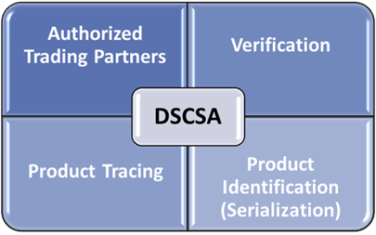
For its part, the pharma industry has tended to see the DSCSA as having four pillars, as illustrated below. These pillars encompass the six requirements we’re talking about today.

DSCSA 2023 Four Pillars

Our own Herb Wong, VP of marketing and strategic initiatives, recently hosted a webinar about DSCSA 2023 readiness that included an overview of the four pillars. It’s a great follow-up to what you’ll read below and a valuable resource for every pharma supply chain stakeholder. If you missed it or want to watch it again, Herb’s webinar is here.

DSCSA 2023: six key requirements

To date, the DSCSA has focused on lot-level traceability, or exchanging information about every package of medication so supply chain stakeholders can see exactly where each has been. DSCSA 2023 is all about complete unit-level serialization through the use of product identifiers, meaning stakeholders will have to electronically track products at the individual package level. Here are the six requirements for DSCSA 2023 laid out in Section 582(g)(1):

  1. Authorized trading partners must exchange transaction information (TI) and a transaction statement (TS) in a secure, interoperable, electronic manner.

TI includes the product name; its strength and dosage form; its National Drug Code; container size and number of containers; lot number; transaction date; shipment date; and the name and address of the businesses from which and to which ownership is being transferred. The TS is an attestation by the business transferring ownership of the product that it has complied with the DSCSA.

Trading partners must maintain all transaction data for 6 years.

The law requires the standards for interoperable exchange of TI to “comply with a form and format developed by a widely recognized international standards development organization.” Right now, EPCIS 4 (Electronic Product Code Information Services) is the only standard that meets this requirement; however, the industry is investigating alternatives.

  1. TI must include the product identifier (PI) at the package level for each package included in the transaction.

The upshot of this requirement is unit-level traceability (i.e., serialization). A PI is a standardized graphic that contains the product’s standardized numerical identifier (SNI), a lot number, and an expiration date. The SNI comprises two data points: the National Drug Code and a unique alphanumeric serial number. PIs must be human- and machine-readable.

  1. Authorized trading partners must have systems and processes to verify products at the package level, including the SNI.

According to the definition in Section 581 of the DSCSA, “verification” or “verify” means determining if the PI “affixed to, or imprinted upon, a package or homogeneous case corresponds to the SNI or lot number and expiration assigned to the product by the manufacturer or the repackager.”

  1. Authorized trading partners must have the systems and processes to promptly respond with the TI and TS for a product upon a request by the Secretary (or other appropriate federal or state official) in the event of a recall or for the purposes of investigating a suspect or illegitimate product.

The “Secretary” here is the commissioner of the U.S. Food and Drug Administration (FDA). Suspect and illegitimate products include drugs that may be counterfeit, diverted, stolen, intentionally adulterated, or unfit for distribution.

This requirement dovetails with the FDA’s push for modernization of the U.S. food supply chain, including recall processes.

  1. Authorized trading partners must have the systems and processes necessary to promptly facilitate gathering the information necessary to produce the TI for each transaction going back to the manufacturer.

This requirement is similar to No. 4 in that authorized trading partners must provide this information to the FDA commissioner or other federal or state officials; however, goes a step further by adding trading partners. The law says these systems and processes

“shall be required in the event of a request by an authorized trading partner, in a secure manner that ensures the protection of confidential commercial information and trade secrets, for purposes of investigating a suspect product or assisting the Secretary (or other appropriate Federal or State official) with a request described in clause.”

  1. Each person accepting a saleable return must have systems and processes in place to allow acceptance the product(s). Furthermore, they may accept saleable returns only if they can associate the returned product(s) with its TI and TS.

This has to do with the DSCSA saleable returns verification requirement and the Verification Router Service (VRS). Supply chain stakeholders must verify saleable returns before they can be reintroduced to the supply chain; they do this by verifying the drug’s PI. The VRS is the system they use to rapidly verify PIs.

rfxcel is the industry leader in the VRS. We led an FDA-approved pilot to extend testing of the VRS and continue to focus on making it ready for DSCSA 2023. Here a few of our resources to answer any questions you may have:

Final thoughts

As we said in Part 1, we’ve been covering the DSCSA for a long, long time. We’ve done webinars, written white papers, and been active in industry initiatives, particularly the VRS and the Open Credentialing Initiative (OCI) to meet the requirements for DSCSA authorized trading partners.

We’ve also been helping pharma companies comply with the DSCSA and other pharma regulations around the world. From our rfxcel Serialization Processing and Compliance Management solutions to the full-scale power of our rfxcel Traceability System, we ensure compliance no matter your role in the supply chain.

So contact us with your questions about DSCSA 2023 or the DSCSA in general. Our supply chain experts can give you a short demonstration of our solutions, share their insights and knowledge, and work with you to ensure you’re compliant today, tomorrow — always.


CRPT Partner in Russia’s Supply Chain: Traceability and Compliance

The Center for Research in Perspective Technologies (CRPT) operates Russia’s National Track and Trace Digital System. Known as Chestny ZNAK, the supply chain system was established by Federal Law No. 425-FZ, signed on December 29, 2017. rfxcel has been prepared for these regulations since 2018, and is now an established CRPT partner.

Let’s take a look at what it means to be a CRPT partner, including the benefits it brings to our customers.

What is the CRPT?

The CRPT is a public-private partnership akin to the European Medicines Verification Organization. Its many responsibilities include generating the serial numbers and verification codes (i.e., crypto codes) required by Chestny ZNAK.

Business giant USM is the CRPT’s principal partner, with a 51 percent stake. USM was founded in 2012 and has interests in many of Russia’s key sectors, including metals/mining, telecom, technology, and internet. According to USM, Chestny ZNAK is the country’s first public-private partnership in the IT sector and the first of its kind at the federal level. Private investments totaling more than 200 billion rubles ($2.5 billion) are expected over the next 15 years.

rfxcel as CRPT partner

Last year, rfxcel earned official CRPT partner status in 10 of the 11 industries for which the organization has chosen partners: medications, footwear, tires, light industry, perfumes, dairy, bottled drinking water, bicycles, wheelchairs, and tobacco. Furthermore, we are the only official CRPT partner for several of these industries.

To be named a CRPT partner, a solutions provider must prove it can work with Chestny ZNAK, comply with its strict serialization requirements, and support companies that do business in Russia.

For example, to be named an official integration, software, and tested solution partner for medications, members of our Moscow team met with the CRPT to demonstrate the rfxcel Traceability System, answer technical questions, and share examples of compliance reports. After an internal evaluation, the CRPT notified rfxcel that it had validated its solution and designated the company as an official partner on its website.

What does being a CRPT partner mean for our customers?

The benefits we bring as a CRPT partner are pretty straightforward. First and foremost, we have proven that our signature rfxcel Traceability System integrates seamlessly with Chestny ZNAK and meets regulatory requirements for key industries.

Russian law calls for serialization, aggregation, unit- and batch-level traceability, crypto codes, and electronic reporting and records management. Our rfxcel Serialization Processing and Compliance Management solutions ensure you’ll comply with these mandated labeling and reporting requirements. Plus, our solutions have a Russian-language user interface that makes integration and start-up much quicker.

The other benefit of being a CRPT partner is that we’re trusted. The CRPT knows our solutions, knows our team in Moscow, and knows that we take compliance very seriously. They know our customers include major pharmaceutical and consumer goods brands. They know we’re committed to making the transformation of Russia’s supply chain smooth and effective, and support the mission “to guarantee the authenticity and declared quality of goods being purchased by customers.”

So, when you work with rfxcel in Russia, you’re working with a CRPT partner that is equipped to deliver quick integration and compliance today, tomorrow — always.

Sneak peek: another recent rfxcel accomplishment in Russia

We’ll share more details about this soon, but earlier this month we received accreditation as an IT company from Russia’s Ministry of Digital Development, Communications, and Mass Media. The Ministry develops and implements national policy and legal regulations for a range of industries, from telecommunications to Internet governance.

That’s all we’ll say for now. The official IT company accreditation is another reason why we continue to be the leader in Chestny ZNAK integration, operability, and compliance.

Final thoughts

We are proud of being an official CRPT partner. It’s proof that our software ensures companies in any industry will remain compliant while they do business in Russia.

Contact us today for more information about how we can help you succeed with Chestny ZNAK. And be sure to download our white paper about Russian compliance. Fully updated for 2021, including information about new pilots for beer and beer-based drinks and biologically active food additives , it’s an easy-to-understand guide to Russia’s strict supply chain regulations for every industry.

New Russian Serialization Pilot for Biologically Active Food Additives

A new Russian serialization pilot for biologically active food additives was announced last month. It’s scheduled to run from April 1 of this year to March 1, 2022.

The government has not said much more than this about the pilot. It has revealed a lot more about the Russian serialization pilot for beer and beer-based drinks, which it announced last October. Read our blog post about that to get all the details.

Let’s take a look at what we do know about the Russian serialization pilot for biologically active food additives. After that, we’ll give you a sneak peek at what we’re doing to make sure stakeholders in every industry regulated by Russia’s National Track and Trace Digital System, known as Chestny ZNAK, know exactly what to do to comply with the strict requirements.

Russian serialization pilot for biologically active food additives

As we said above, the Russian government hasn’t said much about the new pilot, which was formalized through a draft decree entitled “On Conducting an Experiment on the Labeling of Biologically Active Food Additives by Means of Identification in the Territory of the Russian Federation.”

Chestny ZNAK has shared a list of what products will be labeled and their corresponding Eurasian Economic Union Combined Nomenclature of Foreign Economic Activity (TN VED) codes. It’s also been reported that the Center for Research in Perspective Technologies (CRPT), which operates Chestny ZNAK, will provide equipment to pilot participants.

Here are the products that will be included in the Russian serialization pilot for for biologically active food additives. It’s a long list. Be sure to scroll down to our “Final Thoughts” to read about our plans for Russian supply chain compliance!

BIOLOGICALLY ACTIVE FOOD ADDITIVES

Pilot Dates: April 1, 2021–March 1, 2022

TN VED Code Description
1210 20 9000 Oil seeds and oleaginous fruits; miscellaneous grains, seeds, and fruit; industrial or medicinal plants; straw and fodder
1212 21 000 0 Locust beans, seaweeds, and other algae, sugar beet and sugar cane, fresh, chilled, frozen or dried, whether or not ground; fruit stones and kernels and other vegetable products (including unroasted)
1504 10 1000 Fish liver oils and their fractions with Vitamin A content not exceeding 2500 iu/g
1504 20 900 0 Other fish fats, oils, and their fractions, other than fish liver oils, other than solid fractions
1516 10 900 0 Other animal fats and oils and their fractions
1517 90 990 0 Other edible mixtures or preparations of animal or vegetable fats or oils or fractions of different fats or oils of this chapter, other than edible fats or oils
1702 90 950 0 Other, including invert sugar and other sugar and sugar syrup blends containing in the dry state 50% by weight of fructose
1704 90 550 0 Throat and cough lozenges not containing cocoa
1806 31 0000 Other product containing cocoa, in blocks, slabs, or bars, filled
1806 32 100 0 Cocoa and cocoa preparations (other preparations containing cocoa, not filled, but with added cereal grains, fruits, or nuts in blocks, slabs, or bars)
1806 32 900 0 Other preparations containing cocoa, but not filled, in blocks, slabs, or bars
1806 90 700 0 Preparations containing cocoa and intended for manufacture (preparation) of drinks
1806 90 900 0 Other preparations containing cocoa
2101 12 920 1 Preparations with a basis of extracts, essences, or concentrates of coffee
2106 10 800 0 Other protein concentrates and textured protein substances
2106 90 590 0 Other sugar syrups with flavoring or coloring additives
2106 90 920 0 Other food preparations not containing butter fat, sucrose, isoglucose (i.e., high-fructose corn syrup), glucose, and starch, or containing less than 1. 5% by weight of butter fat, 5% by weight of sucrose or isoglucose, 5% by weight
2106 90 980 3 Mixtures of vitamins and minerals for use as a balanced dietary supplement
2106 90 980 9 Other food preparations not elsewhere specified or included
2106 90 9801 Sugar- (sucrose) free chewing gum and/or with a sugar substitute product
2202 90 100 9 “Others” under Code 2202: “Beverages and spirits and vinegar”
2202 99 190 0 Other beverages not containing preparations of headings 0401 to 0404 or fat obtained from preparations of headings 0401 to 0404:

  • 0401: Milk and cream, not concentrated nor containing added sugar or other sweetening matter
  • 0402: Milk and cream, concentrated or containing added sugar or other sweetening matter
  • 0403: Buttermilk, curdled milk and cream, yogurt, kephir (a.k.a. kefir), and other fermented or acidified milk and cream, whether or not concentrated or containing added sugar or other sweetening matter or flavored or…
  • 0404: Whey, whether or not concentrated or containing added sugar or other sweetening matter; products consisting of natural milk constituents, whether or not containing added sugar or other sweetening…
2936 21 000 0 Vitamins A and their derivatives
3002 90 500 0 Cultures of microorganisms
3204 19 000 0 Synthetic organic coloring matter and preparations based thereon, including mixtures of coloring matters of the subheadings 320411 to 320419:

  • 320411: Disperse dyes and preparations based thereon
  • 320412: Acid dyes, whether or not premetallized, and preparations based thereon; mordant dyes and preparations based thereon
  • 320413: Basic dyes and preparations based thereon
  • 320414: Direct dyes and preparations based thereon
  • 320415: Vat dyes (including those usable in that state as pigments) and preparations based thereon
  • 320416: Reactive dyes and preparations based thereon
  • 320417: Pigments and preparations based thereon
  • 320419: Tanning or dyeing extracts; tannins and their derivatives; dyes, pigments, and other coloring matter; paints and varnishes; putty and other mastics; inks
3503 00 100 9 Other gelatin and its derivatives
3507 90 900 0 Other prepared enzymes not elsewhere specified or included

Final thoughts

Our team in Russia fields many, many questions about Chestny ZNAK, and industries that must comply with the supply chain regulations. They love hearing from people and helping them understand the rules for doing business in Russia.

If you follow our blog (and we know you do), you know we’re the leader in Russian compliance. You also know we write a lot about Russian supply chain regulations. Most recently, we covered the pilot for beer, updated labeling requirements for cheese and ice cream products, and “notification mode” in the pharma supply chain. We also did a Chestny ZNAK refresher course.

For even more information, visit our solutions for Russian compliance page, download our latest Chestny ZNAK white paper, and contact our team to schedule a quick demo of our solutions for Russian compliance.