
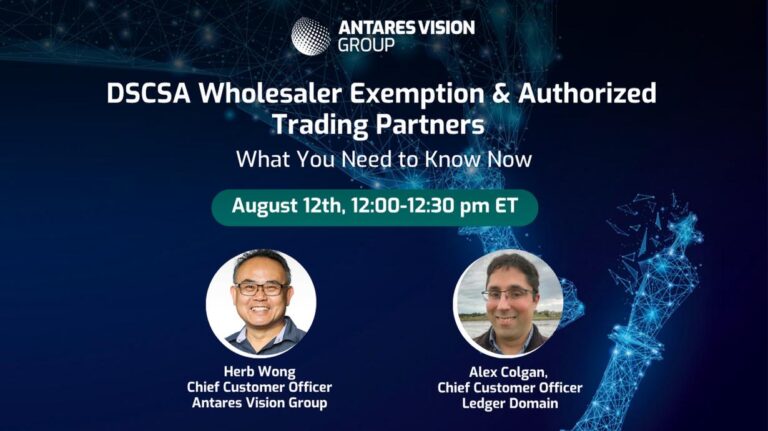
A LinkedIn Live Recap Featuring Alex Colgan at Ledger Domain and Herb Wong at Antares Vision Group
Watch the Full LinkedIn Live Recording
🎧 Listen to the full recording
📄 Transcript included below
Key Takeaways from the Discussion
With the wholesaler exemption ending and full enforcement on the horizon, the pharmaceutical supply chain is entering its most critical DSCSA readiness phase. Manufacturers, wholesalers, and dispensers must now demonstrate serialized data exchange, verification capability, and Authorized Trading Partner (ATP) credentialing.
- Serialized Data Exchange: Strong Progress, but No Room for Missing EPCIS
- According to the Partnership for DSCSA Governance (PDG), 95–100% of wholesalers now receive serialized data — up from 80–95% in March.
-
FDA has clarified that “no EPCIS” is not acceptable. Every shipment must include serialized data.
-
Smaller wholesalers and dispensers with wholesale operations are still catching up technologically, but must meet the same compliance expectations.
- Verification Router Service (VRS): Evolving Use, Expanding Scope
-
Initially built for saleable returns, VRS usage is shifting as serialized data matures.
-
Message volumes are down, but users and use cases are up, particularly among regulators.
-
Expect VRS to play a growing role in regulated verification and trace workflows through 2025.
-
- ATP Credentialing: The Digital Passport for Compliance
-
Authorized Trading Partner (ATP) credentialing acts as a secure, digital signature verifying a company’s DSCSA status.
-
It ensures that verification and trace messages come from trusted, licensed sources — reducing delays, errors, and rejections.
-
The Ledger Domain standard is now used by 14 of the top 20 pharmaceutical companies, major wholesalers, 11,000+ pharmacy sites, and a state regulator.
-
- FDA and State Inspections Are Here
-
State and FDA inspectors have begun asking DSCSA-specific questions during audits.
-
Large dispensers should prepare for inspections tied to their November 27 enforcement milestone.
-
Keep VRS lookup directories accurate and maintain complete ATP audit logs to simplify investigations.
-
- Compliance Lessons: Read the Sterling Distributors 483
-
The FDA 483 warning letter to Sterling Distributors (Florida) is a must-read.
-
It outlines serialization, traceability, and ATP validation failures — effectively a checklist of what not to do.
-
Share it with compliance teams to guide final readiness activities.
-
- Action Steps for the Next 30 Days
- For Wholesalers
- Begin sending serialized data by August 27.
- Ensure inbound EPCIS files are received from all manufacturers.
- Smaller firms can use secure portals — but electronic data is mandatory.
- For Manufacturers
- Prepare for a surge in verification requests (from wholesalers, regulators, and large dispensers).
- Validate VRS directories and ATP credentials.
- For Dispensers
- Prepare for state inspections and internal audits.
- Align patient-need transfer workflows and ensure data privacy in EPCIS transmissions.
- For Wholesalers
🎙️ LinkedIn Live Transcript: DSCSA Wholesaler Exemption & Authorized Trading Partners – The Essentials
Below is the full transcript from the LinkedIn Live session, lightly edited for clarity and formatting.
Moderator: Hi everyone, and thank you for joining this LinkedIn Live session on DSCSA Wholesaler Exemption and Authorized Trading Partners. If you have questions, please drop them in the comments—we’ll answer as many as possible. I’m excited to introduce our speakers: Herb Wong (Antares Vision Group) and Alex Colgan (Ledger Domain).
Herb Wong: I’ve been with Antares Vision Group for more than 11 years and was involved in DSCSA even before it became a federal mandate—when states like Florida and California had their own serialization laws.
Today, I lead customer success and readiness at Antares Vision Group, helping ensure our clients—and the broader industry—are ready for DSCSA enforcement.
Alex Colgan: I’m the Chief Customer Officer at Ledger Domain. We provide secure credentialing and messaging technology that strengthens the pharmaceutical supply chain. We’ve been involved since 2019, helping partners like Antares Vision Group enable secure interoperability across the industry.
With the new enforcement deadline for wholesalers just around the corner, we’re focused on the latest DSCSA developments, the expiration of the wholesaler exemption, and how ATP credentialing ensures trusted, compliant transactions.
Herb Wong: PDG’s June survey showed tremendous progress: nearly all wholesalers now receive serialized data. That’s up significantly from earlier this year.
The FDA understands data quality is still improving, but they’ve made one point clear—missing EPCIS files are no longer acceptable.
Meanwhile, smaller wholesalers and hybrid dispenser-wholesaler operations are still working to align with the DSCSA standard.
Click to expand full transcript
On VRS (Verification Router Service):
Originally designed for saleable returns, VRS has evolved as the ecosystem matures. Even though overall message volume has declined, usage and adoption have grown—especially among regulators. Expect this trend to continue through the end of the year.
Alex Colgan: VRS and EPCIS are part of what we call the Enhanced Drug Distribution Security Network—a connected ecosystem of interoperable solutions.
Tracing is another critical element. It allows us to reconstruct the transaction history of a product—tracking who sold it, who bought it, and where it traveled.
The FDA’s recent 483 warning letter to Sterling Distributors demonstrates the importance of these processes. It’s an example of what happens when companies can’t verify, trace, or respond quickly to suspect product investigations.
With PDG set to release Version 2 of the tracing standard soon, we’re eager to see how it strengthens these interoperable workflows.
Herb Wong: That Sterling letter was widely discussed at last week’s HDA conference—it’s setting the tone for FDA’s next phase of enforcement.
For wholesalers, starting August 27, serialized data must be sent downstream. Without it, your customers can’t process shipments. Manufacturers should also prepare for increased verification requests from both trading partners and regulators.
Accuracy in the VRS directory—the “phone book” of connections—is essential.
Alex Colgan: We’re also seeing regulators ramp up inspections with stronger DSCSA focus. Inspectors are asking specific questions about traceability and ATP validation.
Large dispensers, in particular, should prepare for November inspections and ensure local patient-need transfers and EPCIS data are compliant.
Herb Wong: Before Alex walks through credentialing, I want to recognize the work Ledger Domain has done. Early in the VRS design process, multiple credentialing models were proposed. Alex’s team not only contributed technical innovation but also pushed for open, standards-based collaboration that benefits the entire industry.
Alex Colgan: Thank you, Herb.
At Ledger Domain, we’ve always believed in a standards-driven, interoperable approach.
ATP credentialing serves as a secure, verifiable signature proving your organization is authorized under DSCSA.
Our wallet software signs and validates messages, ensuring everyone—from manufacturers to wholesalers—can securely exchange data.
Today, our credentialing standard is adopted by 14 of the top 20 pharma companies, several major wholesalers, over 11,000 pharmacy sites, and a state regulator.
Herb Wong: For Antares Vision Group customers, integration is seamless. It’s an add-on within your existing contract—no extra vendor selection or onboarding required.
Alex Colgan: Exactly. Credentials minimize compliance risk by ensuring every request and response is traceable to a verified partner. We’ve completed independent GxP audits, disaster recovery testing, and live production scaling.
Herb Wong: An integrated ATP and VRS system means one unified audit log—so when inspections happen, you’re not scrambling across multiple systems to prove compliance.
Alex Colgan: After years of collaboration and testing through FDA and standards groups, the ATP and VRS framework is proven and scalable.
Before enforcement hits, review your VRS directory, ATP setup, and the Sterling 483 letter to benchmark your readiness.
Herb Wong: Thanks to everyone who joined today. We look forward to helping you navigate DSCSA readiness and continuing this discussion offline.
Alex Colgan: Thanks, everyone—have a great summer!
Ready to Strengthen Your DSCSA Readiness?
Contact us to schedule a readiness check, validate your VRS directory, and assess your ATP credentialing strategy.