pharma supply chain Archives - Page 5 of 9 - rfxcel.com
Rfxcel Logo

Understanding GS1 Barcodes in the Global Supply Chain

Where would we be without standards? One thing’s certain: Your supply chain would be a lot messier, if not chaotic if you and your partners didn’t have a “common language” to process and exchange data. Standardized GS1 barcodes are one way we avoid this chaos.

GS1 barcodes keep everybody “on the same page.” They allow companies in virtually every industry to easily record, store, and transfer data. We’ve all seen them, and chances are your organization uses them — maybe even millions or billions of them. But let’s do a quick refresher course as another way to keep us all on the same page.

What is GS1, and why does everyone use GS1 barcodes?

GS1 is an international not-for-profit organization that develops and maintains a broad set of global standards used by businesses the world over. Of the various standards created by the organization, the GS1 barcode is undoubtedly the most well-known. Everyone from Amazon to eBay follows GS1 barcode standards, as these regulations help them easily share additional information about products with consumers and retailers.

A group of U.S. grocery retailers founded GS1 in 1973. Simultaneously, they created the first barcode labels. Since its inception roughly 50 years ago, GS1 has established itself as the leading authority on product identification regulations.

While GS1 general specifications have evolved over the years, the mission behind GS1 has remained unchanged. The organization is committed to promoting operational efficiency and supporting the sharing of information. It does so by providing e-commerce businesses, distributors, manufacturers, and retailers with an easy-to-follow set of labeling standards.

In 2023, GS1 barcodes are contributing to the proliferation of the global commerce ecosystem. Standardized produce labels like barcodes transcend borders, language barriers, and currencies. They enable members of the supply chain to interact on a worldwide scale to the benefit of consumers everywhere.

Why are GS1 barcodes important?

The short answer is, as we said above, standardized GS1 barcodes allow us to maintain order and avoid chaos. Workflows become quicker and more efficient. The GS1 barcodes keep supply chains running by enabling companies to sell, ship, track, reorder, and return products, in most cases by scanning with a handheld device or a camera-based system.

GS1 barcodes also expedite communication, traceability, visibility, and transparency. It’s really all about sharing information quickly in order to know the source of ingredients/components and products, where they’ve been and where they’re going, and when they reach their final destination.

These capabilities not only make supply chains more efficient — they also increase product safety and protect consumers. If there’s a recall, for example, a company can locate its products quickly, make sure shipments are stopped, remove items from stores, and share data with regulators and even consumers.

GS1 barcodes also save money. Administrative costs come down when everybody uses the same standards and has the same expectations. And because GS1 barcodes facilitate digital supply chains, they increase speed and reduce paperwork.

The bottom line is that GS1 barcodes provide members of the supply chain with easy access to product data. In turn, distributors, carriers, and retailers use barcode graphics to trace products throughout the supply chain, optimize operational efficiency, and ensure that consumers are receiving safe and authentic products.

GSI Identification Keys

GS1 standards define a set of unique identification codes, known as identification keys. GS1 says its identification keys “refer unambiguously to a real-world entity,” such as a product, a logistics unit, a physical location, a document, a service relationship, or another entity.

In other words, the ID keys let you quickly and conveniently access information about items in your supply chain and share it with your partners. Only GS1 members can build ID keys, which must include a GS1 company prefix. There are 12 ID keys:

        1. Global Trade Item Number (GTIN): identifies products and services, such as food and clothing
        2. Global Location Number (GLN): identifies parties and locations, such as companies, warehouses, factories, and stores
        3. Serial Shipping Container Code (SSCC): identifies logistics units, such as parcels and palletized products
        4. Global Returnable Asset Identifier (GRAI): identifies returnable assets
        5. Global Individual Asset Identifier (GIAI): identifies assets, such as equipment used in manufacturing and transportation
        6. Global Service Relation Number (GSRN): identifies relationships between service providers and recipients, such as hospital staff and members of brand “loyalty” or rewards programs
        7. Global Document Type Identifier (GDTI): identifies documents, such as shipping paperwork
        8. Global Identification Number for Consignment (GINC): identifies consignments, such as logistics units being transported in a container on a ship or airplane
        9. Global Shipment Identification Number (GSIN): identifies shipments
        10. Global Coupon Number (GCN): identifies coupons
        11. Component/Part Identifier (CPID): identifies components and parts
        12. Global Model Number (GMN): identifies a product’s model number

The GS1 standards also encompass data capture, including definitions of barcode and radio-frequency identification (RFID) data carriers, that allow ID keys and other data to be affixed directly to an object. Data standards also address the hardware to read and produce barcodes (e.g., scanners and printers), and hardware and software to connect the barcodes and RFID tags to business applications.

The different types of GS1 barcodes

All GS1 barcodes are “containers” that can hold different amounts information, such as serial numbers, batch numbers, GTINs, and expiration dates. As the image below from GS1 shows, there are four types, or “families,” of barcodes: EAN/UPC, two-dimensional (2D), DataBar, and one-dimensional (1D).
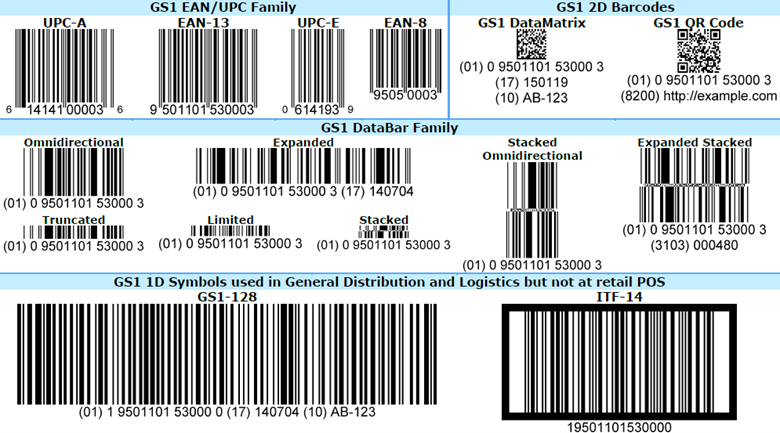
GS1 barcodes

EAN/UPC family. GS1 says, rightly, that these “are printed on virtually every consumer product in the world.” They are characterized by a series of vertical lines and a horizontal row of numbers, and come in four types: UPC-A, EAN-13, UPC-E, and EAN-8.

These GS1 barcodes are designed to be used at the point of sale and can be read by omnidirectional scanners. None support attributes — they cannot contain product information such as an expiration date, a batch number, or item weight. UPC-A has 12 numbers and supports GTIN-12; EAN-13 has 13 numbers and supports GTIN-13; UPC-E has 12 numbers (the zeros are “suppressed) and supports GTIN-12; and EAN-8 has 8 numbers and supports GTIN-8.

2D barcodes. Like EAN/UPC barcodes, 2D barcodes are ubiquitous. They are incredibly robust, able to hold dense product information and remain legible at greatly reduced sizes or when they’re etched into a surface, such as a plastic bottle cap. There are two kinds of 2D barcodes:

      1. GS1 DataMatrix codes are omnidirectional and support attributes and all GS1 ID keys. They can hold 3,116 numeric or 2,335 alphanumeric characters.
      2. GS1 QR codes are also omnidirectional and support attributes and all GS1 ID keys. They can hold 7,089 numbers or 4,296 alphanumeric characters.

DataBar family. There are seven members in the DataBar family. Generally, they’re divided into two groups: those designed for use at the point of sale (i.e., can be read by omnidirectional scanners) and those that are not.

The first group has four types: omnidirectional, stacked omnidirectional, expanded, and expanded stacked.

      • Omnidirectional and stacked omnidirectional have 14 numbers. They support GTINs and Global Coupon Numbers (GCNs) but do not support attributes.
      • Expanded and expanded stacked have a maximum capacity of 74 numeric and 41 alphabetic characters. They support GTINs and GCNs, but do support attributes.

There are three types of barcodes in the second group: truncated, limited, and stacked. These have 14 numbers and support GTINs, but do not support attributes. They are not designed for use at the point of sale, so they cannot be read by omnidirectional scanners.

1D barcodes. The two types of 1D barcodes — GS1-128 and ITF-14 — are used in retail distribution, healthcare, and logistics. GS1-128 barcodes can carry any GS1 ID key and up to 48 alphanumeric characters, including serial numbers, expiration dates, and other information that helps track products through a supply chain. More than one GS1-128 barcode can be used on a single item. ITF-14 barcodes can hold only GTINs; GS1 says it is suitable for printing on corrugated materials.

Final thoughts

This year was the 50th anniversary of the GTIN. As GS1 said, “It is no exaggeration to say that the development of the GTIN set the stage for global, digitalized commerce.” Indeed, labeling standards and barcode technologies have evolved and advanced since 1971 to the great benefit of businesses and consumers alike.

We have been talking about the advantages of end-to-end traceability in a digital supply chain for a long time. When your products, labeled with powerful identifiers such as 2D DataMatrix codes, move through a digital supply chain powered by our award-winning Traceability System, you can leverage rich, unit-level data for much more than compliance and operational efficiency: You can create genuine, tangible business value. For example:

That’s really just the beginning of what a digital supply chain can do. To learn more, contact us today to see a short demo of our solutions. Our supply chain experts will show you how our Traceability System transforms your supply into your most valuable strategic asset.
What is the Drug Supply Chain Security Act (DSCSA)?

Today’s question: What is the Drug Supply Chain Security Act (DSCSA)?

The Drug Supply Chain Security Act (DSCSA) was passed on November 27, 2013. Envisioning a 10-year journey leading to the complete serialization of the U.S. pharma supply chain and electronic, interoperable exchange of product information, the law is scheduled to take effect on November 27, 2023.

We’ve written extensively about the legislation, but with the deadline for full compliance quickly approaching, we thought an overview was in order.

So let’s take a look at the DSCSA from top to bottom — milestones, requirements, highlights, expectations, and challenges — and answer the question, What is the Drug Supply Chain Security Act?

The Most Recent DSCSA Developments

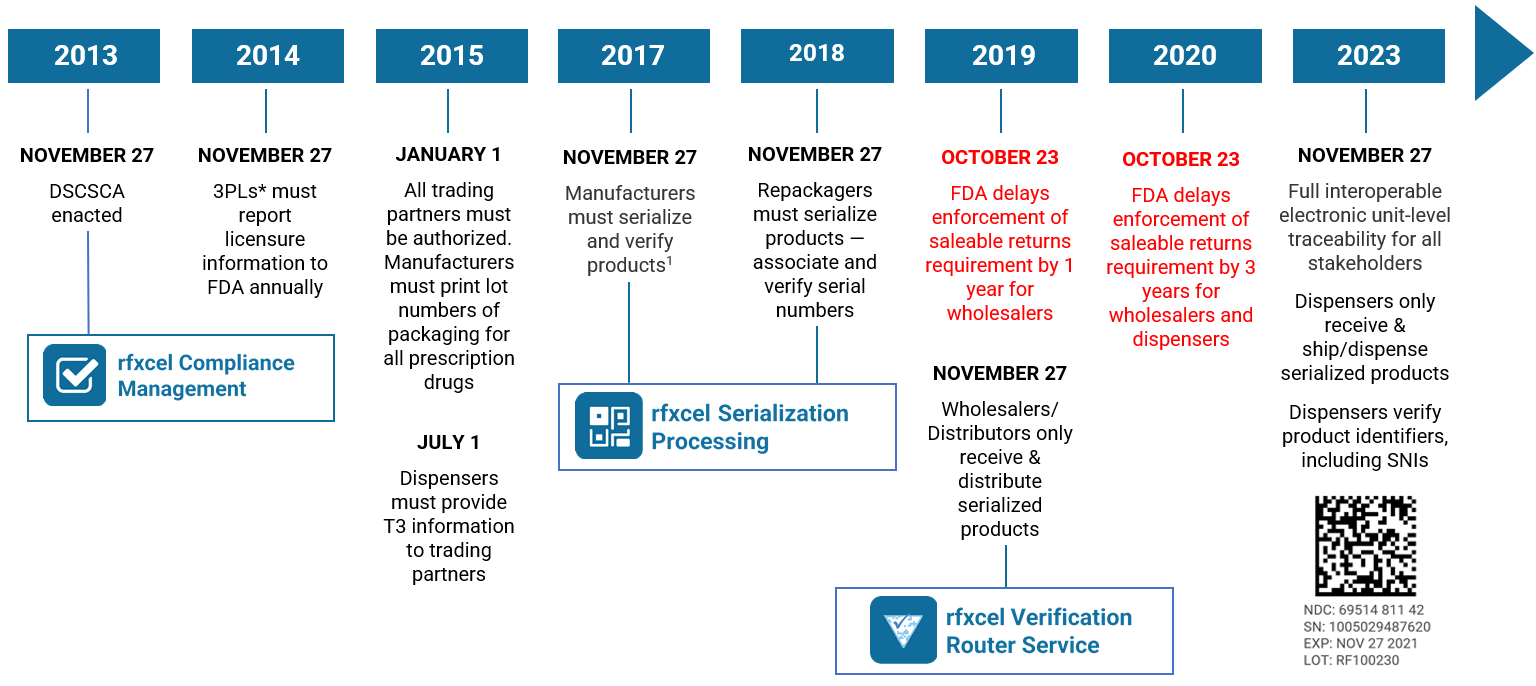
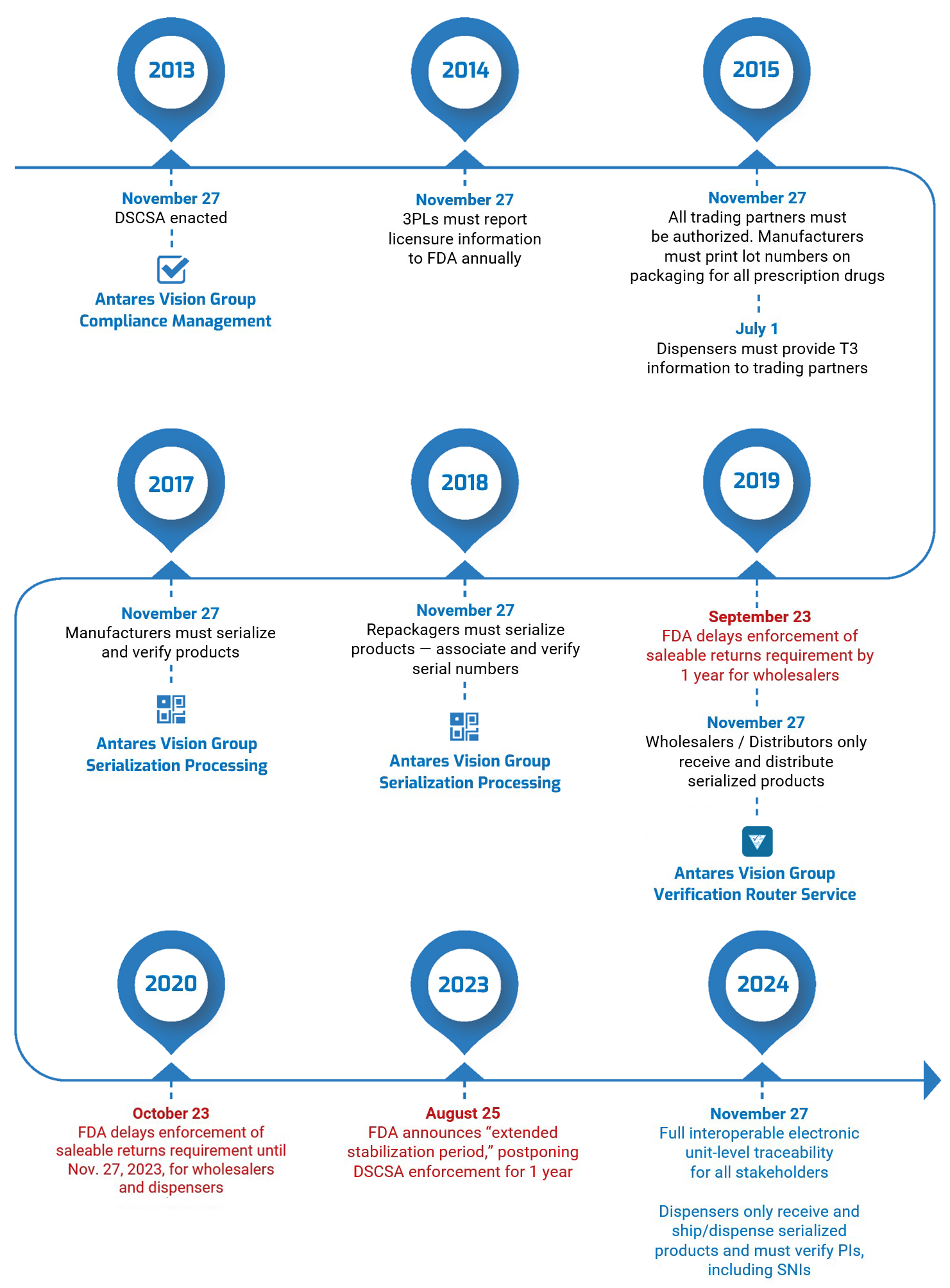
As the timeline below shows, the FDA has adjusted DSCSA compliance deadlines during the rollout. The most recent — and arguably most significant — happened in August 2023, when the Agency announced that it was delaying by one year enforcement of key DSCSA requirements. This “extended stabilization period” moves the enforcement date to November 27, 2024.

However, it’s vital that all supply chain actors understand that the original compliance deadline of November 27, 2023, still stands. The Agency has made it clear that the stabilization period is not a delay of the 2023 requirements: It expects companies to have implemented the mandated systems and work to ensure they are operating correctly, smoothly, etc.

In Enhanced Drug Distribution Security Requirements Under Section 582(g)(1) of the Federal Food, Drug, and Cosmetic Act — Compliance Policies, the FDA states:

This guidance is not intended to provide, and should not be viewed as providing, a justification for delaying efforts by trading partners to implement the enhanced drug distribution security requirements under section 582(g)(1) of the FD&C Act. FDA strongly urges trading partners to continue their efforts to implement necessary measures to satisfy these enhanced drug distribution security requirements.

So what’s the key takeaway: Don’t stop preparing for the DSCSA. If you have questions about the DSCSA stabilization period or are concerned that your current provider isn’t doing everything it can to set you up for success, we encourage you to contact us today to speak with one of our DSCSA experts. We are 100 percent committed to ensuring all of our customers meet DSCSA compliance.

DSCSA Timeline

A timeline showing key dates of the U.S. Drug Supply Chain Security Act (DSCSA) from 2013 to 2024

DSCSA at a Glance

Created as Title II of the Drug Quality and Security Act (DQSA), passed by Congress in November 2013, the DSCSA is an initiative to prevent the introduction and distribution of counterfeit, stolen, contaminated, or otherwise harmful drugs in the United States. It outlines steps to build an interoperable electronic system to identify and trace prescription drugs as they are distributed throughout the country. By providing comprehensive FDA guidance, the act facilitates the accurate tracing of products from the point of production to distribution to dispensation and beyond.

Understanding the Drug Supply Chain Security Act

If you’re a pharmaceutical company — a manufacturer, wholesaler, dispenser, repackager, or third-party logistics provider — you must comply with the Drug Supply Chain Security Act (DSCSA) if you want to do business in the United States.

The U.S. Food and Drug Administration (FDA) says the goal of the DSCSA is “to build an electronic, interoperable system to identify and trace certain prescription drugs as they are distributed in the United States.” The Act “will enhance [the] FDA’s ability to help protect consumers from exposure to drugs that may be counterfeit, stolen, contaminated, or otherwise harmful” and “improve detection and removal of potentially dangerous drugs from the drug supply chain to protect U.S. consumers.”

As we said above, the law has been rolled out in phases since it was passed nearly 10 years ago. Even though enforcement was delayed until November 2024, the FDA expects all supply chain stakeholders to keep preparing.

Key Requirements of the Drug Supply Chain Security Act

The DSCSA requirements can be divided into several categories that apply to manufacturers, repackagers, wholesale distributors, dispensers, and 3PLs. Each is important, but four are particularly vital to being ready for November 2023 because they require these stakeholders to have specific systems in place to be fully compliant. These are the “four cornerstones” of DSCSA compliance:

Product identification (serialization)

Manufacturers and repackagers must put a unique product identifier (PI), such as a bar code, on certain prescription drug packages. This must be able to be read electronically.

Product tracing

Manufacturers, wholesale distributors, repackagers, and many dispensers (primarily pharmacies) must provide certain information about the drug and who handled it each time it’s sold:

      • Transaction information (TI) includes the product name; its strength and dosage form; its National Drug Code (NDC); container size and number of containers; lot number; transaction date; shipment date; and the name and address of the businesses from which and to which ownership is being transferred.
      • The transaction statement (TS) is a paper or electronic attestation by the business transferring ownership of the product that it has complied with the DSCSA.
      • A third type of information, Transaction history (TH), is an electronic statement with the TI for every transaction going back to the manufacturer. It is required before the November 27, 2023, deadline; it is not required after that date.

Verification

Manufacturers, wholesale distributors, repackagers, and dispensers must establish systems and processes to verify PIs for certain prescription drug packages. For saleable returns, manufacturers and wholesale distributors must use the Verification Router Service (VRS). Like everything else in the DSCSA, we’ve written extensively about the VRS. Our “DSCSA Saleable Returns Verification Requirement: Just the Facts” article is a good place to start.

Authorized trading partners (ATPs)

All manufacturers, wholesale distributors, repackagers, 3PLs, and dispensers must be ATPs and be able to electronically verify that their trading partners are ATPs.

In broad terms, to be an ATP you must meet certain registration, licensing, and licensure reporting requirements under the Federal Food, Drug, and Cosmetic Act (FD&C Act) and comply with state licensing requirements. The definitions of ATP also include language about accepting or transferring direct ownership or possession of products.

There are “four cornerstones” of DSCSA compliance requirements:

Other DSCSA Requirements to Consider

Detection and response + notification: Stakeholders must quarantine and promptly investigate suspect or illegitimate drugs. They must also notify the FDA and other interested parties when they find such drugs.

Licensing: Wholesalers must report their licensing status and contact information to the FDA. Third-party logistics providers must obtain a state or federal license.

Final thoughts

What is the Drug Supply Chain Security Act? The DSCSA requires pharma stakeholders to work together to secure the U.S. supply chain. It doesn’t matter if you’re a manufacturer, wholesaler, repackager, third-party logistics provider, or a dispenser — the law affects how you conduct business. Your compliance depends on making sure you can meet your responsibilities.

That’s where rfxcel comes in.

We have 20 years of experience providing the pharmaceutical industry with leading regulatory and compliance software. So if you aren’t sure if you’re going to be ready for DSCSA 2023–2024 or you’re wondering if your current solution provider is doing everything it can to prepare you for compliance, contact us today.

Our DSCSA experts can show you a short demo of our solutions, clarify what your responsibilities are, and answer questions about your needs and how to meet them, no matter your role in the supply chain.

In the meantime, check out some of our other DSCSA resources, including our DSCSA: Preparing for the Full Serialization of the U.S. Pharmaceutical Supply Chain white paper and our DSCSA 2023 webinar series. These are great resources to help you better understand the law. You can click on those links or jump right to our DSCSA Compliance Library, a clearinghouse of all our information about the law.

Drug Supply Chain Security Act (DSCSA) Pharmacy Responsibilities

Drug Supply Chain Security Act pharmacy responsibilities are complex. They can be confusing. But the clock continues to count down to the final compliance deadline.

On August 25, 2023, the U.S. Food and Drug Administration (FDA) announced that it was delaying by one year enforcement of key DSCSA requirements. This “extended stabilization period” moves the enforcement date to November 27, 2024. Read our blog post here for all the details.

If you want to ensure that your business processes comply with DSCSA pharmacy regulations, the first step is to familiarize yourself with the nuances of the law. With that in mind, let’s do a quick recap for pharmacies.

What is the U.S. Drug Supply Chain Security Act?

The U.S. Drug Supply Chain Security Act, enacted on November 27, 2013, establishes a system to track and trace prescription drugs in a fully serialized supply chain. It calls for end-to-end traceability and electronic interoperability to prevent counterfeit, stolen, contaminated, or otherwise harmful drugs from entering the U.S. supply chain.

So far, the DSCSA has mostly focused on lot-level traceability — exchanging information about every package of medication so stakeholders can see exactly where it has been. Enactment will culminate next year with complete unit-level serialization of the U.S. drug supply chain. This means stakeholders will have to electronically track products at the individual package level.

As the final link in the pharmaceutical supply chain, pharmacies are the last safeguard between suspect products and patients. They are responsible for gathering transaction information and reviewing supply chain data to verify the legitimacy of products (more on that below).

Drug Supply Chain Security Act pharmacy responsibilities: definitions

Pharmacies are referred to as “dispensers” in the DSCSA. The legislation defines a dispenser as “a retail pharmacy, hospital pharmacy, a group of chain pharmacies under common ownership and control that do not act as a wholesale distributor, or any other person authorized by law to dispense or administer prescription drugs, and the affiliated warehouses or distribution centers of such entities under common ownership and control that do not act as a wholesale distributor.”

If you dispense only products to be used in animals, you are not a dispenser under the DSCSA. The DSCSA pharmacy requirements apply only to dispensers that provide medication to patients or end-users. If your pharmacy is providing medications to another dispenser or another member of the pharmaceutical supply chain, it is acting as a distributor, which means other DSCSA requirements would apply.

How to comply with the DSCSA

Compliance is mandatory if you are a dispenser under DSCSA pharmacy requirements. Failure to comply will raise flags with the FDA and open your organization to penalties, including fines.

As we said above, the Drug Supply Chain Security Act pharmacy responsibilities are complex. Let’s break them down into easy-to-understand pieces.

You must exchange information about every drug you buy and who handled it each time it changes ownership in the United States.

The DSCSA calls this “product tracing information,” and it has three components, collectively referred to as “T3 information”:

  1. Transaction Information (TI) about a product (e.g., proprietary or established name or names and the strength and dosage form)
  2. Transaction Statement (TS), which is an electronic statement confirming the entity transferring ownership.
  3. Transaction history (TH), an electronic statement with the TI for every transaction going back to the manufacturer. TH is required only until the November 27, 2024, deadline.

Under DSCSA pharmacy requirements, you have to obtain and exchange this data for every transaction. The purpose of these traceability requirements is to promote drug distribution security and to identify potential discrepancies in the supply chain records. If a product cannot be traced back to a legitimate source, it is considered “suspect.”

Adhering to these transaction requirements will help pharmacies protect their consumers from illegitimate drug products. Traceability standards also help the FDA ensure that suspect prescription drugs do not enter the supply chain in the first place.

You must receive, store, and provide product tracing documentation

You can accept prescription drugs only if they have proper tracing information, and you must store the information for six years. You must also generate and provide all information when you sell a prescription drug to a trading partner.

If the FDA conducts a DSCSA pharmacy audit, it can examine records dating back six years. If information is missing, you will be found in violation of the DSCSA and could face substantial penalties.

Providing product traceability information is another important part of DSCSA pharmacy requirements, as pharmacies frequently send inventory to other companies within their healthcare networks. When you engage in these activities, you are acting as a distributor and must adhere to all relevant standards regarding the creation of lot numbers and product-level tracing.

You can only do business with authorized trading partners (ATPs)

And speaking of trading partners, if you can’t confirm your they’re licensed or registered, you can’t do business with them. If they’re not authorized, their access to the U.S. pharma supply chain will be severely restricted or denied altogether. Read our in-depth ATP blog series for all the details.

For now, we will provide a brief recap of what constitutes an ATP under the DSCSA guidelines. The FDA states that an authorized partner is:

  • A manufacturer or repackager that has a valid registration with the FDA
  • A wholesale distributor that has a valid license under state law
  • A third-party logistics provider (3PL) that has a valid license in accordance with state law
  • A dispenser that has a valid license in accordance with state law

The FDA defines a trading partner as:

  • An entity (i.e., manufacturer, distributor, repackager, or dispenser) that accepts director ownership of a product from a manufacturer
  • An entity that transfers direct ownership of a product
  • A 3PL that accepts or transfers products to another entity in the supply chain

In other words, an ATP is an entity that is appropriately licensed and accepts or transfers direct ownership of a regulated pharmaceutical product. Before a pharmacy does business with a repackager, wholesaler, or distributor, it must verify the organization’s ATP status.

You must investigate and properly handle suspect and illegitimate drugs

Suspect and illegitimate drugs include drugs that may be counterfeit, diverted, stolen, intentionally adulterated, or unfit for distribution — the problem the DSCSA was designed to eliminate. Pharmacies must quarantine and investigate these drugs to determine if they are fake. If you make this determination, the next step is to work with the manufacturer and take specific action to ensure the bad drug does not reach patients/consumers. You must also notify the FDA and your trading partners about the drug.

Identifying illegitimate products is one of the most important roles of pharmacists under DSCSA requirements. It is also one of the most challenging tasks, as each pharmacist and pharmacy technician must be trained on how to identify illegitimate or suspect products. All pharmacies should train their employees about the DSCSA requirements (e.g., abnormalities in transaction information) and other methods to identify suspect products.

You must authenticate and verify drugs

This is what’s coming in 2024. You’ll have to be able to authenticate and verify all the medicines you buy before you can sell them. The fundamental requirement is that TI (transaction information) must include a product identifier (PI), which includes serial numbers and expiration dates. The Electronic Product Code Information Services (EPCIS) is likely to be the standard the industry will use to enable this exchange.

EPCIS is a standard from GS1, an international organization responsible for creating and maintaining operational standards for key industries, including healthcare. EPCIS is a means to electronically share the “what, when, where, why, and how” information about pharmaceutical products, promoting end-to-end traceability and interoperability among supply chain actors.

Final thoughts

Navigating complex compliance requirements and adapting to new standards can present challenges. Fortunately, you have options — like partnering with rfxcel to help you meet DSCSA pharmacy requirements.

Even though the enforcement deadline has been extended until November 2024, the time to act is now. If you aren’t sure you’ll be ready, contact us to schedule a short demo of our DSCSA pharmacy compliance solutions, which include robust traceability tools, data management solutions, and more. As an rfxcel partner, you’ll tap into the expertise of our DSCSA pharmacy compliance experts, who will collaborate with you to design a solution to ensure you meet all DSCSA requirements and remain compliant forever.

We also invite you to download our DSCSA compliance white paper. It drills down into what we talked about today and is a great reference tool to have on hand as you prepare for the full serialization of the U.S. pharma supply chain. Also bookmark our DSCSA compliance library, which has all our resources about the law.

Understanding the Two Parts of the Drug Quality and Security Act (DQSA)

The Drug Quality and Security Act (DQSA) was enacted on November 27, 2013, to address gaps and oversights in the way compound medications — medications that are customized by combining, mixing, or altering two or more drugs to meet the needs of a specific patient — are prepared and distributed. It was a response to the inadvertent distribution of contaminated steroidal injections that killed 64 people and caused infections in 793 patients.

The DQSA comprises two pieces of legislation: The Compounding Quality Act and the Drug Supply Chain Security Act (DSCSA). Here’s a quick overview of each.

DQSA Part 1: The Compounding Quality Act

The goal of the Compounding Quality Act is to make compounded medicines safer for patients.  It established a registration system for pharmaceutical industry stakeholders that create sterile drugs (e.g., manufacturers and pharmacies). It also reinstated Section 503A of the Food, Drug, and Cosmetic Act (FD&C Act), parts of which the Supreme Court in 2002 ruled unconstitutional.

Companies can register as an official outsourcing facility if they meet a specific set of criteria. Outsourcing facilities are usually larger companies that supply compounds to healthcare facilities such as pharmacies, hospitals, and clinics. The key requirements for outsourcing facilities under the Compounding Quality Act include the following:

  • They must report adverse events to the FDA twice a year.
  • They must submit reports about all compounded medications to the FDA twice a year
  • They must meet product labeling requirements.
  • They must agree to FDA inspections (according to a “risk-based schedule” and pay fees for any re-inspections.
  • They must pay a registration fee to the FDA.

Outsourcing facilities are also subject to increased quality standards and can be penalized for certain actions, including intentionally falsifying prescriptions for compounded medicines, failing to report adverse events or compounded medications to the FDA, making false claims about compounded medicines (i.e., false advertising), and selling medications with “not for resale” warnings.

All this said, it’s important to note that the FDA does not approve compounded drugs. The Agency does not verify their safety or effectiveness. Furthermore, compounded drugs do not have an FDA finding of manufacturing quality before they are marketed.

DQSA Part 2: The Drug Supply Chain Security Act (DSCSA)

The DSCSA is a wide-ranging piece of legislation designed to prevent counterfeit, stolen, contaminated, or otherwise harmful drugs from entering the U.S. pharmaceutical supply chain. It affects virtually every industry stakeholder, from manufacturers, distributors, and wholesalers to repackagers, logistics providers, and dispensers (i.e., pharmacies). It is

Enacted in November 2013 and culminating with the November 2023 deadline, the ultimate goal of the DSCSA is a fully serialized pharmaceutical supply chain with full electronic operability. There are four core requirements:

  1. Product serialization
  2. Product tracing
  3. Verification (of product identifiers)
  4. Authorized trading partners

If you follow our blog, you know we’ve been writing about the DSCSA for years. For a longer summary, check out “Countdown to DSCSA 2023 Serialization: The Deadline Is Two Years Away.” For an in-depth look at what’s in store for 2023, read “DSCSA 2023: The Future of Pharmaceutical Traceability in the USA.”

Final thoughts

rfxcel has been the leading provider of regulatory and compliance software for the pharmaceutical industry for almost 20 years. We’ve also been a thought leader on the DQSA and DSCSA compliance. Our goal is to keep all stakeholders informed and work with them to ensure they’re ready to meet all the requirements in 2023.

Below are a few of our most recent resources to help bring you up to speed. Take a look, and if you have any questions or want to see a short demo of our DQSA and DSCSA solutions, contact us today. Our supply chain experts know the legislation inside and out and will work with you to design a solution that’s right for you.

Brand Protection Strategies and Your Supply Chain

Welcome to Part II of our brand protection series. In Part I, we talked about the top supply chain threats that brand protection strategies must address: counterfeits, diversion, theft, and insufficient traceability.

Today, we’re talking about the supply chain solutions that combat these threats — solutions that should be integral to your brand protection strategies.

A holistic supply chain approach to brand protection strategies

Your supply chain is the embodiment of your business. If it’s not healthy, your brand can’t be healthy. You need to be able to continuously scan it, diagnose it, and take immediate action should a threat arise.

Fine-tuned digital supply chain solutions are the answer. Working together from end to end, they create a “central nervous system” that monitors and senses every touch point in real time while collecting and sharing data to inform your next move.

Serialization, real-time monitoring, and end-to-end traceability are the key solutions that help mitigate supply chain threats and provide the intelligence for effective brand protection strategies. Let’s take a look.

Serialization

Serialization is the building block of a secure supply chain and effective brand protection strategies. By assigning a unique serial number to each product, you create what rfxcel calls a “digital asset” with a unique digital identity. Every product can be linked to virtually any information you want, such as its origin, when it was harvested or manufactured, its lot number, and its expiration date.

Serialization also enables you to track every individual unit through your entire supply chain, from production to retail distribution to the final consumer and beyond. It creates a barrier to fight counterfeits and fakes and contributes to end-to-end traceability that eliminates blind spots and locks down your supply chain.

Serialization also fuels brand protection strategies because you can leverage each digital asset for consumer engagement to build confidence and trust. As we said in Part I of our consumer engagement series, your customers are absolutely a part of brand protection, and serialization empowers them in three important ways.

First, it’s the basis of an indelible, demonstrable, shareable product provenance that proves that your product is what you say it is and gives consumers the information they demand.

Second, as we discussed in Part II of our consumer engagement series, your serialized product is a device for one-on-one communication with your customers. For example, with a quick smartphone scan of a 2D Data Matrix code, a person can access rich data about your product and exclusive content through which they’ll establish and build a relationship with your brand.

Third, serialization lets you “crowdsource” brand protection through your consumer engagement activities. For example, if a person scans a product and the scan doesn’t work or they’re taken to a suspect website or other suspicious content, you can incentivize them to contact you and report that something is wrong. This is actionable, granular data that will protect your brand.

Real-time monitoring

A blind spot in your supply chain creates opportunities for trouble. Common blind spots include deviations from prescribed routes and harmful environmental conditions. The solution is real-time monitoring.

rfxcel’s Integrated Monitoring solution paints a vibrant, detailed picture of where your products are and what is happening to them. It provides better data, continuity, visibility, and security to protect your products and consumers. With detailed, unit-level data coming in around the clock, you’ll understand and immediately act upon specific risks.

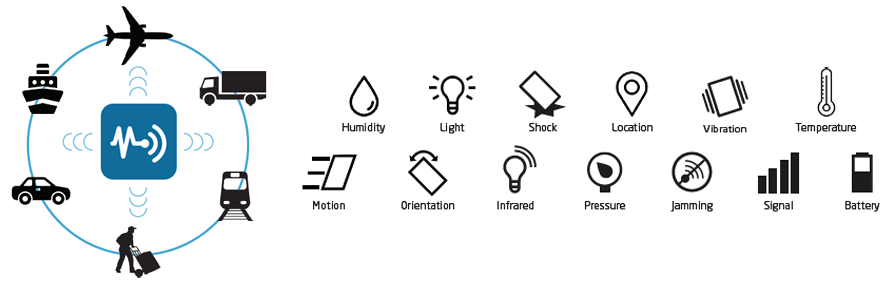
It works like this: Pallets, cases, or unit-level items are equipped with Internet of Things (IoT)-enabled sensors that send data over communication networks at regular intervals. The sensors provide real-time information about how long an item has been in transit, if the transport vehicle is sticking to its approved route, if the shipment stopped and for how long, and environmental conditions such as temperature, light, humidity, and shock. If something is not as it’s supposed to be, the sensors transmit an alert so you can halt shipments that may have been adulterated and redirect shipments to keep products safe. You’ll protect your customers and safeguard your brand.

Check out our short videos about our Integrated Monitoring solution for the pharmaceutical and food and beverage industries.

End-to-end traceability

End-to-end traceability in a digital supply chain means you can design end-to-end brand protection strategies.

With a suite of solutions acting in concert — like our Traceability System — you’ll create a full, traceable provenance for every product. You can add critical tracking events and key data elements at any point in your supply chain. For example, add a photo of a product as it leaves the factory or integrate a quality inspection to enrich the data associated with the product. Consumers can access this information and confirm that your product is what you say it is. This burnishes your reputation and builds trust with the people who buy your products or are thinking about buying your products.

rfxcel Traceability System

And there are numerous other benefits of end-to-end traceability. If you can see every part of your supply chain from one end to the other, you’ll be able to manage operations more efficiently, including dealing with recalls and other crisis situations. You’ll make it harder for counterfeits and fakes to reach consumers. You’ll consolidate data to improve processes, outcomes, and product quality. And you’ll be empowered to make better decisions based on that data.

Mobile traceability: an on-the-go solution for brand protection strategies

A discussion of brand protection strategies isn’t complete without mentioning mobile traceability. Why? Because if you don’t have access to your supply chain data 24/7, no matter where you are, you’re not shedding light on blind spots and not building a solid perimeter around your brand.

rfxcel’s MobileTraceability solution brings our industry-leading track and trace capabilities to virtually any location, including places that traditionally may not have had absolute visibility in your supply chain, such as remote fields, distribution centers, and warehouses. With unparalleled convenience and speed, it gives you everything you need to keep you supply chain running at optimal efficiency. To learn more, read about what our Mobile Traceability solution can do for the pharmaceutical and food and beverage supply chains.

Final thoughts

A supply chain problem is a brand protection problem. By giving all your products a unique digital identity through serialization, then following and controlling them in real time with integrated monitoring and traceability solutions, you can demonstrate to the world that your brand is strong and reliable. You can build a reputation for integrity and transparency with partners and consumers. You can use data to innovate your brand protection strategies, consumer engagement activities, and every part of your operations.

With rfxcel, you can fortify your brand with data from a digital supply chain. You can combat the threats we’ve discussed no matter where you are and no matter where you supply chain goes. Contact us today to see how our solutions can work for better, stronger brand protection strategies.

Brand Protection Strategy and the Top Supply Chain Threats

We just did two articles about why your supply chain is vital to an effective consumer engagement strategy. Now we want to jump into brand protection strategy and your supply chain.

First, let’s define our terms. Although consumer engagement is a usually a dedicated effort to boost brand recognition and loyalty, it must always be considered part of your brand protection strategy. As we’ll see, getting your customers involved in fighting counterfeits and identifying disreputable sellers and other bad actors is critical. Let’s continue breaking this down.

Why do you need a brand protection strategy?

Do you want to protect your business? Your employees, your bottom line, your reputation, your supply chain, your intellectual property?

Of course you do. Your brand protection strategy is your firewall. It’s how you shield your business from things that can harm it. And many — if not most — of the factors that can harm your brand are directly related to your supply chain. These include counterfeits (also called fakes), diversion, theft, and insufficient traceability.

Top supply chain threats

Let’s take a closer look at the top supply threats your brand protection strategy should address.

Counterfeits and fakes

The joke is that the best way to fight counterfeits is to make products nobody wants to buy.

We know that’s not how it works, though, which is why counterfeits and fakes are the No. 1 brand protection concern. In fact, counterfeits and pirated products accounted for up to 3.3 percent of world trade in 2016.

That statistic comes from a 2019 report by the Organisation for Economic Co-operation and Development (OECD) entitled “Trends in Trade in Counterfeit and Pirated Goods.” The OECD also found that trade in counterfeit and pirated goods was rising steadily despite stagnation in overall trade volumes. Based on 2016 customs seizure data, the value of imported fake goods worldwide was $509 billion, up from $461 billion in 2013.

But there’s a lot more to be concerned about. Counterfeits are of inferior quality and often contain harmful, even deadly, materials/ingredients. The people who make them, including children, often work for long hours in sweatshop conditions. Some may have been trafficked or coerced. Furthermore, it has been established that counterfeits are inextricably linked to organized crime.

The pandemic provided many examples counterfeits making their way into the global supply chain — fake vaccines, fake COVID-19 testing kits, fake masks, fake nitrile gloves. But counterfeiting affects every industry, from food and footwear to cosmetics and computers.

Diversion and theft

When your goods are in transit along your supply chain, you want them to reach their final destination as quickly and safely as possible. This is why diversion is another key consideration for a brand protection strategy.

Diversion is actually a two-pronged problem. Let’s use pharmaceuticals to illustrate. Many drugs must be kept within a certain temperature range or maintained under certain lighting or humidity conditions. Even the slightest delay could spell disaster — ruined products, which means patients might not get medicines on time.

Diversion can also indicate theft. If a truck goes off its prescribed route, bad actors might be hijacking it and your product could end up on unauthorized e-commerce sites (rogue websites) and other grey markets or black markets. If the diversion has compromised the integrity of your product — a drug, for example — people’s lives may be jeopardized.

Insufficient traceability

As we’ve discussed before, supply chain traceability brings tangible value to just about every part of your business, including your brand protection strategy. If you’re not taking traceability seriously, you’re not just opening the door to assaults on your brand; you’re risking problems with regulators, alienating (and losing) customers, and weakening your supply chain.

A recall is among the most damaging events that can happen to a brand, so let’s use it as case study. If you can trace a recalled item, you can better collaborate with trading partners and authorities and help to get the product out of the supply chain and out of stores. With traceability, you’re protecting consumers from a health hazard and safeguarding your brand from bad publicity. And with a transparent approach to engaging with customers about your products, you create a strong brand image that conveys trust, credibility, and reliability.

Traceability also helps fight counterfeits, diversion, and theft. The ability to trace and authenticate every product in your supply chain in real time, 24/7, is foundational to an effective brand protection strategy. We’ll get into those details in Part II of our brand protection series.

Final thoughts

At the end of August, the Office of the United States Trade Representative published a request for comments “that identify online and physical markets to be considered for inclusion in the 2021 Review of Notorious Markets for Counterfeiting and Piracy (Notorious Markets List).”

Counterfeits have also been making headlines in recent weeks:

In this environment, a comprehensive brand protection strategy driven by granular supply chain data is your best defense against bad actors. rfxcel understands this. We can help you leverage your supply chain to combat counterfeits and the other concerns we addressed today. Our brand protection solutions will fortify your brand with data from a digital supply chain. Contact us today to learn more — and read Part II of our brand protection series.

Top Reasons Your Supply Chain Is the Key to an Effective Consumer Engagement Strategy

Welcome to Part II of our series about effective consumer engagement. In Part I, we talked about the benefits of consumer engagement. Today, we’re focusing on your supply chain — and how you can use it for a next-level consumer engagement strategy. Let’s jump right in.

It’s all about data from your supply chain

Your supply chain is a gold mine of information that you can leverage for a robust consumer engagement strategy. The basic building block is serialization, which turns each one of your products into what we call “digital assets.” Each digital asset has a unique digital identity that can be monitored from production all the way to the person who buys it.

With rich, traceable data about every item in your supply chain at your fingertips, you can establish and maintain connections with consumers before, during, and after the sale. (You can also do much, much more, but that’s beyond the scope of what we’re talking about today.)

Four ways supply chain data supercharges your consumer engagement strategy

1. You’ll share the product information that consumers demand.

Consumers demand information. Every product — every digital asset — in your supply chain can be “loaded” with data that consumers can access at the store, at home, at a restaurant, at a sporting event. Anywhere. For example, a quick scan of a 2D Data Matrix code or QR code with a smart phone will reveal every detail you want to share about your product: where and when it was grown or made, its ingredients, the route it took to get to the consumer. This demonstrable provenance using supply chain data builds consumer trust and confidence; it is foundational to consumer engagement.

2. You’ll create compelling customer experiences.

Consumers also want experiences. With data from your supply chain and other brand resources (e.g., an app) you can curate experiences such as contests, loyalty programs, games, and unique online content. You can encourage storytelling about your brand. If you’re a winemaker, connect people to a virtual tour of your vineyard. If you sell organic foods, share video recipes online or invite people to see your sustainable operations. If you make cosmetics, link to virtual try-ons. Importantly, you can hyper-personalize and hyper-target every engagement, and even “broadcast” specific information to specific locations or events.

3. You’ll communicate directly with consumers.

Your serialized product is a device for one-on-one communication with the person who bought it. When a customer accesses the information from your digital asset, you can connect them to your website, social media, an app, a survey, or other forums where they can start a conversation with your brand. They can ask questions and provide feedback — and you can give answers and reactions. Relationship-building is another cornerstone of an effective consumer engagement strategy, and the products people are literally holding in their hands are the first step of the conversation.

4. You’ll gain valuable insight into your customers.

An effective consumer engagement strategy creates a world for your customers. And as they navigate and participate in that world, they share information. Where are they buying your products? What do they like? What don’t they like? What inspires them? What engagement activities resonated the most? This business intelligence can inform every part of your business, from how your supply chain works to creating better consumer engagement strategies.

Final thoughts

The purchase used to be the last part of your supply chain; now it’s the beginning of a new realm of possibilities. Every digital asset is an opportunity to connect your customers to your brand and put your products front and center in their lives.

rfxcel’s Traceability System is an end-to-end supply chain solution that creates the digital assets. It gives you in-depth, real-time insights all the way from production to your final customers. The data you connect to your products will fuel compelling consumer engagement activities that can reach people everywhere you do business.

And now, as part of Antares Vision Group, we can offer even more ways to engage with consumers. Contact us today to find out more.


BONUS CONTENT!

Last year, we did a piece called “Supply-Chain Traceability Is Building a New Kind of Consumer Kingdom.” Here’s an excerpt that ties into what we’ve said about an effective consumer engagement strategy:

In fact, consumers are not only thinking deeply about where the things they buy come from and what goes into making them, they are actually becoming a pivotal part of the supply chain itself. What’s more, they’re participating willingly and with gusto, demanding detailed information about the goods they purchase and even expecting to interact with products far beyond the point of sale. Just how far will they go to get what they want? More than 70% of customers say they’re willing to share their data in exchange for a more personalized experience, according to one recent survey.

Read the full article here.

DSCSA Serialization Implementation and Compliance Guidelines

Note: This article was originally published in November 2021. We’ve since updated some language after the FDA announced on August 25, 2023, that it was delaying by one year enforcement of key DSCSA requirements.

November 27, 2023 — the date the pharmaceutical industry has had its sights on since the U.S. Drug Supply Chain Security Act (DSCSA) was enacted eight years ago. With only two years until the deadline, we thought it was a good time to recap what’s in store for DSCSA serialization.

What is DSCSA serialization?

DSCSA serialization is not different from serialization any other industry: It means that certain drugs must traceable at the unit level. Specifically, manufacturers and repackagers must put a unique Product Identifier (PI), such as a bar code, on certain prescription drug packages. This must be able to be read electronically. Furthermore, manufacturers, wholesale distributors, repackagers, and many dispensers (primarily pharmacies) must provide certain information about drug and who handled it each time it’s sold:

  • Transaction information (TI) includes the product name; its strength and dosage form; its National Drug Code (NDC); container size and number of containers; lot number; transaction date; shipment date; and the name and address of the businesses from which and to which ownership is being transferred.
    • The transaction statement (TS) is a paper or electronic attestation by the business transfer-ring ownership of the product that it has com-plied with the DSCSA.
    • A third type of information, Transaction history (TH), is an electronic statement with the TI for every transaction going back to the manufacturer. It is not required after the law goes into effect on November 27, 2023; however, as we wrote about before, there is a “stabilization period” in effect until November 27, 2024, during which the FDA does not intend to take enforcement action. Read more about that here and below.

Meeting DSCSA serialization requirements is vital for all pharmaceutical supply chain members. Whether you are a manufacturer, wholesale distributor, or dispenser, DSCSA 2023 requirements apply to your business. The question is, are you ready?

The DSCSA 2023 deadline

As we just said, the DSCSA 2023 compliance deadline is still November 27. But the FDA postponed enforcement by one year to November 27, 2024. This change does not affect past deadlines on the DSCSA enforcement timeline, but does have implications for DSCSA requirements, including serialization.

This means that pharma stakeholders — manufacturers, wholesale distributors, repackagers, dispensers, and third-party logistics providers (3PLs) — now have an extra 12 months to get their systems in order. However, the FDA has made it clear that these entities should not regard the “stabilization period” as a delay of the 2023 requirements: It expects companies to have implemented the mandated systems and work to ensure they are operating correctly, smoothly, etc. The Agency’s Enhanced Drug Distribution Security Requirements Under Section 582(g)(1) of the Federal Food, Drug, and Cosmetic Act — Compliance Policies states:

This guidance is not intended to provide, and should not be viewed as providing, a justification for delaying efforts by trading partners to implement the enhanced drug distribution security requirements under section 582(g)(1) of the FD&C Act. FDA strongly urges trading partners to continue their efforts to implement necessary measures to satisfy these enhanced drug distribution security requirements. 

The DSCSA timeline

November 27, 2023, will be the 10th anniversary of the DSCSA. Per Section 582(g)(1) of the DSCSA (Title II of the Drug Quality and Security Act), “On the date that is 10 years after the date of enactment of the Drug Supply Chain Security Act … interoperable, electronic tracing of product at the package level requirements shall go into effect.” In other words, DSCSA 2023 serialization.

DSCSA 2023 Serialization Timeline

DSCSA serialization: recent developments

No more delays. On August 9, 2021, the FDA signaled that the DSCSA 2023 deadline for interoperability would not change. Leigh Verbois, the director of the FDA’s Office of Drug Security, Integrity, and Response, made the comments during a webinar hosted by the Healthcare Distribution Alliance (HDA).

Draft and final guidance on product identifiers (PIs) and more. On June 3, 2021, the FDA published “new guidance to further enhance the security of prescription drugs in the U.S. supply chain.” Guidance was released for PIs, suspect and illegitimate products, and enhanced drug distribution security.

Full serialization

For DSCSA serialization, certain drug packages must be labeled with a unique Product Identifier (PI). The PI comprises the National Drug Code, a serial number, a lot number, and an expiration date.

Furthermore, every time a product changes hands (i.e., between trading partners), supply chain actors must use the Electronic Product Code Information Services (EPCIS) to share Transaction Information (TI) and a Transaction Statement (TS) with their partners. A third requirement, Transaction History (TH), will not be required after the November 2023 deadline.

Even with the stabilization period until November 27, 2024, there’s no stopping the fact that significant changes are coming for pharmaceutical traceability under DSCSA. The primary focus? Serialization. Serialization involves assigning unique identifiers to each pharmaceutical product, enabling precise tracking and data reporting at every stage of its journey through the supply chain.

Authorized trading partners

Under the DSCSA, authorized trading partners (ATPs) may engage in transactions only with other ATPs. In other words, all manufacturers, wholesale distributors, repackagers, 3PLs, and dispensers and their trading partners must be ATPs. If they’re not authorized, their access to the U.S. pharma supply chain will be severely restricted or denied altogether. Read our in-depth ATP blog series here.

Verification Router Service (VRS)

Under the DSCSA saleable returns verification requirement, wholesalers must verify saleable returns before they can be reintroduced to the supply chain. This is done by verifying the drug’s PI. A wholesaler must initiate a verification request (to a manufacturer) to verify the returned products, and the manufacturer must provide a verification response within 24 hours. The VRS enables the rapid, secure exchange of data between these parties. Get more details here.

Final thoughts: DSCSA Serialization

We have been talking about and reporting on the DSCSA Day 1. We’ve been active in industry initiatives, particularly the VRS and the Open Credentialing Initiative (OCI) to meet ATP requirements. We’re ensuring the Ohio Department of Veterans Affairs is DSCSA-compliant. And we’ll soon be announcing another exciting initiative in the move toward full serialization of the U.S. pharma supply chain. Keep an eye out for that.

This year, we hosted a “Plan for DSCSA Readiness” webinar in March and a DSCSA 2023 webinar series in June that covered ATPs, EPCIS, and the VRS. We also published a “Dispensers and DSCSA 2023” white paper in May.

We’ve also been helping pharma companies and public-sector organizations comply with the DSCSA and other pharma regulations around the world. From our Serialization Processing and Compliance Management solutions to the full-scale power of our Traceability System, we ensure compliance no matter your role in the supply chain.

Take another look at our DSCSA timeline. A lot has happened since 2013 — and the pace will only intensify over the next two years. Contact us today if you need to know more. Our supply chain and DSCSA experts are here to help and make sure you’re ready for 2023


Antares Vision Group to Showcase Its Ecosystem of Production and Supply Chain Management Solutions at CPhI Worldwide in Milan

The company is attending the exhibition with end-to-end solutions that connect quality, safety, and efficiency

Travagliato, Italy, November 9,  2021. Antares Vision Group, whose mission is to accelerate technological innovation and digitalization by connecting the physical and digital worlds with the integrated value chain, will be exhibiting its ecosystem of production and supply chain management solutions at CPhI Worldwide November 9–11 in Milan.

The digitalization of production systems and supply chains has become a fundamental element of guaranteeing opportunities for innovation in many industries. The ability to transform physical processes into data and information opens channels of communication among all stakeholders, ensuring safety, transparency, and sustainability of processes at every stage of the supply chain.

This will be a central topic at CPhI Worldwide, one of the most important international events for the pharmaceutical industry. Now in its 32nd year — and returning to Milan after 14 years — CPhI will be held at the Fiera Milano exhibition hall from November 9 to 11, with more than 800 exhibitors from 170 countries representing every facet of the industry’s supply chain.

Antares Vision Group will exhibit in Hall 10, Stand L30, P-MEC, highlighting the synergy of expertise from its companies with a unique ecosystem of technologies and benefits dedicated to the pharmaceutical supply chain. This complete and integrated ecosystem comprises solutions for production, including traceability, quality control with automatic visual inspection machines (the result of a multi-technological approach), and intelligent data management (Efficiency 4.0), and solutions for the end-to-end supply chain, from raw materials to production, from distribution to the hospital and the patient.

Emidio Zorzella, CEO and co-founder of Antares Vision S.p.A., said, “We are happy to once again exhibit at CPhI Worldwide. This is a premier industry event and the perfect occasion for us to highlight ourselves as a partner and single point of reference for all stakeholders in the pharmaceutical supply chain. Thanks to the experience and technological synergies within our Group, we offer an ecosystem of solutions to manage the quality and safety of products and will lead the digital transformation of supply chains.”

The collection and interconnection of data — quality, traceability, IoT devices, and data from each step of the supply chain — contribute to the construction of a transparent and complete supply chain of information that empowers every participant to know and verify the integrity and history of every product. Digital identities for each smart product and a transparency that generates trust: This is the power of Trustparency®.

About Antares Vision Group

Antares Vision Group protects products, people, and brands with inspection systems featuring 6,500 quality controls, track and trace software solutions for end-to-end transparency and visibility in digital supply chains, and smart data management tools for maximum operational efficiency, from raw materials to final consumers. It provides solutions to five primary industries: pharmaceuticals and life sciences (medical devices and hospitals), food and beverage, cosmetics, and consumer packaged goods. Active in more than 60 countries, Antares Vision Group has seven production facilities and three Innovation and Research Centers in Italy, 22 foreign subsidiaries, and a global network of more than 40 partners. Today, 10 of the world’s 20 leading pharmaceutical companies use its solutions to secure their production and supply chain operations; worldwide, it has deployed more than 25,000 inspection systems and more than 3,500 serialization modules. Antares Vision Group has been listed on the Italian Stock Exchange’s AIM Italia market since April 2019 and in the STAR Segment of the Mercato Telematico Azionario (MTA) since May 2021. www.antaresvisiongroup.com

Further information

Davide Antonioli, Antares Vision PR Specialist: davide.antonioli@antaresvision.com | +39 339 8124446

Brazil ANVISA Update: Manufacturers, Distributors, and Dispensers Must Meet April 2022 Serialization Deadline

The Brazilian Health Regulatory Agency (ANVISA) has approved its final Normative Instruction (NI 100), meaning the April 28, 2022, deadline for meeting serialization, reporting, and traceability requirements is officially set in stone. Let’s take a look at what supply chain stakeholders can expect with Brazil ANVISA when the law goes into effect just six months from now.

Key Brazil ANVISA requirements for April 28, 2022

The pharma industry has been aware of the Brazil ANVISA requirements since December 2016, when the National Medicine Control System (SNCM) was signed into law (Law No. 13.410/2016), establishing serialization requirements and timelines for Brazil’s pharmaceutical supply chain.

There are three key requirements for April 2022:

  1. All prescription medicines must be serialized.
  2. All manufacturers and importers must have a “serialization plan” in the SNCM portal.
  3. All supply chain stakeholders must submit product event reports to the SNCM.

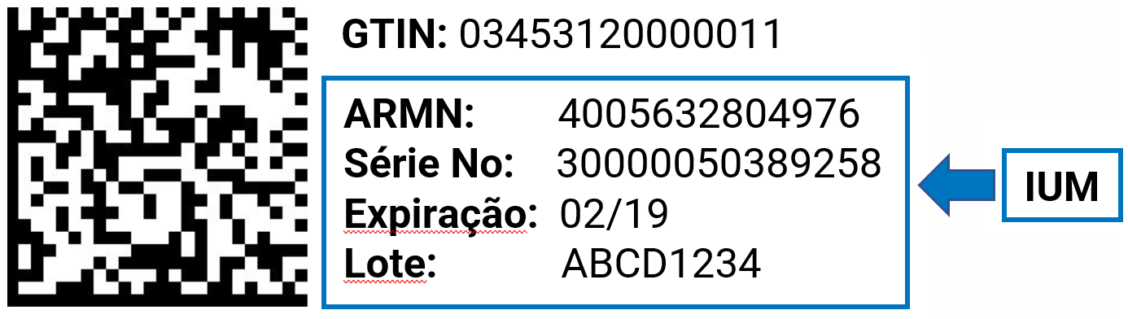
To meet serialization requirements, all products must have a GS1 2D Data Matrix barcode that houses a Global Trade Item Number (GTIN), a 13-digit ANVISA Medicine Registry Number, a unique 13-digit serial number, an expiration date (in the MM/YY format for human-readable form), and a lot/batch number (up to 20 alphanumeric characters).

The ANVISA Medicine Registry Number, serial number, expiration date, and lot/batch number make up the Unique Medicine Identifier (Identificador Único de Medicamentos), or IUM, which must be printed on every product. Compliant labeling might look something like this:

Brazil ANVISA IUM

For their serialization plans in the SNCM portal, manufacturers and importers must provide information about their relevant product lines and medicines. Furthermore, manufacturers must submit a serialization plan that includes all steps and actions they will take to become compliant by April 2022.

Final thoughts

What’s the most important takeaway for Brazil ANVISA? The clock is ticking and you have to be prepared. You should be coordinating with your supply chain partners. You should be registering your products with ANVISA. You should have access to the SNCM portal and be uploading the required reporting data.

You should also register for our “SNCM-ANVISA Serialization and Traceability Compliance” webinar on Wednesday, Nov. 17, 8:30 – 9:15 a.m. Eastern Time. Thiago Alegreti, director of our Latin American operations, will discuss the latest SNCM updates and let you know what you need to be doing to be ready for April 2022.

rfxcel has fine-tuned our traceability software to help manufacturers operating in the Brazilian market comply with the SNCM requirements, and we have an experienced team on the ground in Brazil that can help make sure you’re ready for the regulations. Register for the webinar and contact us today if you have any questions or want more information.