Pharma Blog Archives - Page 5 of 8 - rfxcel.com
Rfxcel Logo

rfxcel DSCSA 2023 Webinar Series: Sneak Peek #3

Our first DSCSA 2023 webinar is today, June 15, at noon Eastern Time! Registration is still open, so sign up now!

For the next three days, our Executive Global Advisor Brian Files, an expert on U.S. and international pharmaceutical compliance, will present key aspects of the DSCSA and answer your questions.

  1. TODAY, JUNE 15: The Verification Router Service: Aligning to the Standard
  2. Wednesday, June 16: ASN to EPCIS: Industry Change, Your Challenge
  3. Thursday, June 17: Authorized Trading Partners: The OCI Solution

We’ve already done sneak peeks about today’s Verification Router Service webinar and Thursday’s presentation about authorized trading partners. Here’s our last sneak peek about “ASN to EPCIS.” Enjoy! And remember to sign up for the series. All registrants can download the webinars starting next week.

What is the DSCSA?

The DSCSA went into effect on November 27, 2013. It calls for product tracing, product identifiers (PIs), authorized trading partners, and verification requirements for manufacturers, wholesale distributors, repackagers, and dispensers (pharmacies). Full serialization will begin on November 27, 2023.

DSCSA requirements for electronic data exchange

Trading partners must provide transaction information (TI) and a transaction statement (TS) to the subsequent owner of a product “prior to, or at the time of, each transaction.” This information must “be exchanged in a secure, interoperable, electronic manner in accordance with the standards established [through FDA guidance].”

In 2023, TI must include product identifiers (PIs), which include serial numbers and expiration dates. This is part of the full serialization of the U.S. pharmaceutical supply chain.

The FDA puts a premium on these requirements, saying, “electronic, interoperable exchange of TI is … foundational to achieving electronic interoperable tracing and verification … .”

What is ASN?

An advanced shipping notice (ASN) tells what’s being shipped (e.g., number of items, shipment date, number of boxes, shipment weight, description of packaging) and how it’s being shipped (e.g., land, sea, air).

Why are people talking about ASN? Because it does not currently support DSCSA 2023 requirements for including PIs. What are the ramifications?

What is EPCIS?

The Electronic Product Code Information Service (EPCIS) is a global GS1 standard for exchanging Electronic Product Code (EPC) information and enables automatic communication and exchange of authenticated data.

Right now, it seems to be the pharma industry’s preference for meeting DSCSA requirements — but will it remain the frontrunner, or will another standard gain favor?

Final thoughts

Again, head over to our registration page so you can join Brian today, tomorrow, and Thursday. All the webinars begin at noon Eastern Time and will last up to 45 minutes (depending on how long our Q&A goes).

See you at the webinars!

DSCSA 2023 Webinar_June 15-17


rfxcel DSCSA 2023 Webinar Series: Sneak Peek #1

Full serialization of the U.S. pharmaceutical supply chain is coming in November 2023. That may seem like a long way off, but time flies and it will be here before you know it. To help make sure you’re working toward that deadline and doing everything you can to be prepared, we’re hosting the rfxcel DSCSA 2023 webinar series on June 15, 16, and 17.

Our Executive Global Advisor Brian Files, an expert on U.S. and international pharmaceutical compliance, will present three key aspects of the DSCSA and answer your questions. Sign up today!

  1. Tuesday, June 15: The Verification Router Service: Aligning to the Standard
  2. Wednesday, June 16: ASN to EPCIS: Industry Change, Your Challenge
  3. Thursday, June 17: Authorized Trading Partners: The OCI Solution

Here’s a sneak peek about the DSCSA Verification Router Service (VRS). Check back for more sneak peeks leading up to Brian’s other presentations in our rfxcel DSCSA 2023 webinar series!

What is the DSCSA?

The DSCSA went into effect on November 27, 2013. It calls for product tracing, product identifiers (PIs), authorized trading partners, and verification requirements for manufacturers, wholesale distributors, repackagers, and dispensers (pharmacies). As we said above, full serialization will begin in November 2023 (the 27th, to be exact).

What is the DSCSA saleable returns verification requirement?

Under the DSCSA saleable returns verification requirement, wholesalers must verify saleable returns before they can be reintroduced to the supply chain. This is done by verifying the drug’s PI, which comprises a Standardized Numerical Identifier (National Drug Code and a unique alphanumeric serial number), a lot ID, and an expiration date.

How does the DSCSA saleable returns requirement work?

A wholesaler must initiate a verification request (to a manufacturer) to verify the returned products. The manufacturer must provide a verification response within 24 hours. Wholesalers are called requestors and manufacturers are called responders.

The VRS and the DSCSA saleable returns verification requirement

The VRS enables the rapid, secure exchange of data between requestors and responders to meet the DSCSA saleable returns verification requirement. It’s an automated service that verifies if a PI is valid. A solution provider enables the verification requests to be routed between wholesalers and manufacturers.

Final thoughts

Be sure to join Brian on June 15 for “The Verification Router Service: Aligning to the Standard,” the first in our rfxcel DSCSA 2023 webinar series. Register today and submit your questions for Brian. You can also contact us to talk with one of our supply chain experts and see how our award-winning rfxcel Traceability System can ensure you comply with the saleable returns verification requirement and other key DSCSA requirements.

See you on June 15!

DSCSA 2023 Webinar_June 15-17

DSCSA 2023: Unlocking the Future of Pharmaceutical Traceability in the USA

Welcome to the third and final installment of our DSCSA 2023 series. The first two parts talked about DSCSA authorized trading partners — manufacturers, wholesale distributors, repackagers, third-party logistics providers, and dispensers. If you’re not a DSCSA authorized trading partner, it will be difficult to do business in the United States, so be sure to read Part 1 and Part 2.

Today, we’re focusing on the day we’ve all been preparing for: November 27, 2023, the 10th anniversary of the DSCSA. Per Section 582(g)(1) of the DSCSA (Title II of the Drug Quality and Security Act):

“On the date that is 10 years after the date of enactment of the Drug Supply Chain Security Act … interoperable, electronic tracing of product at the package level requirements shall go into effect.”

So, in a little more than 2 years and 8 months from now, the U.S. pharmaceutical supply chain will be fully serialized. Let’s take a closer look at what this means for the pharma industry and its authorized trading partners.

A quick clarification

This blog post looks at “the letter of the law” — the language in Section 582(g)(1) that lays out six requirements for DSCSA 2023.

For its part, the pharma industry has tended to see the DSCSA as having four pillars, as illustrated below. These pillars encompass the six requirements we’re talking about today.
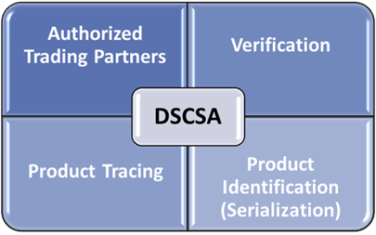
DSCSA 2023 Four Pillars

Our own Herb Wong, VP of marketing and strategic initiatives, recently hosted a webinar about DSCSA 2023 readiness that included an overview of the four pillars. It’s a great follow-up to what you’ll read below and a valuable resource for every pharma supply chain stakeholder. If you missed it or want to watch it again, Herb’s webinar is here.

DSCSA 2023: six key requirements

To date, the DSCSA has focused on lot-level traceability, or exchanging information about every package of medication so supply chain stakeholders can see exactly where each has been. DSCSA 2023 is all about complete unit-level serialization through the use of product identifiers, meaning stakeholders will have to electronically track products at the individual package level. Here are the six requirements for DSCSA 2023 laid out in Section 582(g)(1):

  1. Authorized trading partners must exchange transaction information (TI) and a transaction statement (TS) in a secure, interoperable, electronic manner.

TI includes the product name; its strength and dosage form; its National Drug Code; container size and number of containers; lot number; transaction date; shipment date; and the name and address of the businesses from which and to which ownership is being transferred. The TS is an attestation by the business transferring ownership of the product that it has complied with the DSCSA.

Trading partners must maintain all transaction data for 6 years.

The law requires the standards for interoperable exchange of TI to “comply with a form and format developed by a widely recognized international standards development organization.” Right now, EPCIS 4 (Electronic Product Code Information Services) is the only standard that meets this requirement; however, the industry is investigating alternatives.

  1. TI must include the product identifier (PI) at the package level for each package included in the transaction.

The upshot of this requirement is unit-level traceability (i.e., serialization). A PI is a standardized graphic that contains the product’s standardized numerical identifier (SNI), a lot number, and an expiration date. The SNI comprises two data points: the National Drug Code and a unique alphanumeric serial number. PIs must be human- and machine-readable.

  1. Authorized trading partners must have systems and processes to verify products at the package level, including the SNI.

According to the definition in Section 581 of the DSCSA, “verification” or “verify” means determining if the PI “affixed to, or imprinted upon, a package or homogeneous case corresponds to the SNI or lot number and expiration assigned to the product by the manufacturer or the repackager.”

  1. Authorized trading partners must have the systems and processes to promptly respond with the TI and TS for a product upon a request by the Secretary (or other appropriate federal or state official) in the event of a recall or for the purposes of investigating a suspect or illegitimate product.

The “Secretary” here is the commissioner of the U.S. Food and Drug Administration (FDA). Suspect and illegitimate products include drugs that may be counterfeit, diverted, stolen, intentionally adulterated, or unfit for distribution.

This requirement dovetails with the FDA’s push for modernization of the U.S. food supply chain, including recall processes.

  1. Authorized trading partners must have the systems and processes necessary to promptly facilitate gathering the information necessary to produce the TI for each transaction going back to the manufacturer.

This requirement is similar to No. 4 in that authorized trading partners must provide this information to the FDA commissioner or other federal or state officials; however, goes a step further by adding trading partners. The law says these systems and processes

“shall be required in the event of a request by an authorized trading partner, in a secure manner that ensures the protection of confidential commercial information and trade secrets, for purposes of investigating a suspect product or assisting the Secretary (or other appropriate Federal or State official) with a request described in clause.”

  1. Each person accepting a saleable return must have systems and processes in place to allow acceptance the product(s). Furthermore, they may accept saleable returns only if they can associate the returned product(s) with its TI and TS.

This has to do with the DSCSA saleable returns verification requirement and the Verification Router Service (VRS). Supply chain stakeholders must verify saleable returns before they can be reintroduced to the supply chain; they do this by verifying the drug’s PI. The VRS is the system they use to rapidly verify PIs.

rfxcel is the industry leader in the VRS. We led an FDA-approved pilot to extend testing of the VRS and continue to focus on making it ready for DSCSA 2023. Here a few of our resources to answer any questions you may have:

Final thoughts

As we said in Part 1, we’ve been covering the DSCSA for a long, long time. We’ve done webinars, written white papers, and been active in industry initiatives, particularly the VRS and the Open Credentialing Initiative (OCI) to meet the requirements for DSCSA authorized trading partners.

We’ve also been helping pharma companies comply with the DSCSA and other pharma regulations around the world. From our rfxcel Serialization Processing and Compliance Management solutions to the full-scale power of our rfxcel Traceability System, we ensure compliance no matter your role in the supply chain.

So contact us with your questions about DSCSA 2023 or the DSCSA in general. Our supply chain experts can give you a short demonstration of our solutions, share their insights and knowledge, and work with you to ensure you’re compliant today, tomorrow — always.



CRPT Partner in Russia’s Supply Chain: Traceability and Compliance

The Center for Research in Perspective Technologies (CRPT) operates Russia’s National Track and Trace Digital System. Known as Chestny ZNAK, the supply chain system was established by Federal Law No. 425-FZ, signed on December 29, 2017. rfxcel has been prepared for these regulations since 2018, and is now an established CRPT partner.

Let’s take a look at what it means to be a CRPT partner, including the benefits it brings to our customers.

What is the CRPT?

The CRPT is a public-private partnership akin to the European Medicines Verification Organization. Its many responsibilities include generating the serial numbers and verification codes (i.e., crypto codes) required by Chestny ZNAK.

Business giant USM is the CRPT’s principal partner, with a 51 percent stake. USM was founded in 2012 and has interests in many of Russia’s key sectors, including metals/mining, telecom, technology, and internet. According to USM, Chestny ZNAK is the country’s first public-private partnership in the IT sector and the first of its kind at the federal level. Private investments totaling more than 200 billion rubles ($2.5 billion) are expected over the next 15 years.

rfxcel as CRPT partner

Last year, rfxcel earned official CRPT partner status in 10 of the 11 industries for which the organization has chosen partners: medications, footwear, tires, light industry, perfumes, dairy, bottled drinking water, bicycles, wheelchairs, and tobacco. Furthermore, we are the only official CRPT partner for several of these industries.

To be named a CRPT partner, a solutions provider must prove it can work with Chestny ZNAK, comply with its strict serialization requirements, and support companies that do business in Russia.

For example, to be named an official integration, software, and tested solution partner for medications, members of our Moscow team met with the CRPT to demonstrate the rfxcel Traceability System, answer technical questions, and share examples of compliance reports. After an internal evaluation, the CRPT notified rfxcel that it had validated its solution and designated the company as an official partner on its website.

What does being a CRPT partner mean for our customers?

The benefits we bring as a CRPT partner are pretty straightforward. First and foremost, we have proven that our signature rfxcel Traceability System integrates seamlessly with Chestny ZNAK and meets regulatory requirements for key industries.

Russian law calls for serialization, aggregation, unit- and batch-level traceability, crypto codes, and electronic reporting and records management. Our rfxcel Serialization Processing and Compliance Management solutions ensure you’ll comply with these mandated labeling and reporting requirements. Plus, our solutions have a Russian-language user interface that makes integration and start-up much quicker.

The other benefit of being a CRPT partner is that we’re trusted. The CRPT knows our solutions, knows our team in Moscow, and knows that we take compliance very seriously. They know our customers include major pharmaceutical and consumer goods brands. They know we’re committed to making the transformation of Russia’s supply chain smooth and effective, and support the mission “to guarantee the authenticity and declared quality of goods being purchased by customers.”

So, when you work with rfxcel in Russia, you’re working with a CRPT partner that is equipped to deliver quick integration and compliance today, tomorrow — always.

Sneak peek: another recent rfxcel accomplishment in Russia

We’ll share more details about this soon, but earlier this month we received accreditation as an IT company from Russia’s Ministry of Digital Development, Communications, and Mass Media. The Ministry develops and implements national policy and legal regulations for a range of industries, from telecommunications to Internet governance.

That’s all we’ll say for now. The official IT company accreditation is another reason why we continue to be the leader in Chestny ZNAK integration, operability, and compliance.

Final thoughts

We are proud of being an official CRPT partner. It’s proof that our software ensures companies in any industry will remain compliant while they do business in Russia.

Contact us today for more information about how we can help you succeed with Chestny ZNAK. And be sure to download our white paper about Russian compliance. Fully updated for 2021, including information about new pilots for beer and beer-based drinks and biologically active food additives , it’s an easy-to-understand guide to Russia’s strict supply chain regulations for every industry.

What Does the EU COVID-19 Vaccine Distribution Plan Look Like?

The EU announced its COVID-19 vaccine strategy on June 17, 2020. Among other things, it called for ensuring the quality, safety, and efficacy of vaccines, securing quick access to vaccines, and ensuring equitable access to an affordable vaccine as early as possible. It also called for adapting the EU’s regulatory framework and taking advantage of regulatory flexibility to address the urgent need.

Let’s take a look at what the EU has said about its COVID-19 vaccine distribution plan and answer some frequently asked questions about its vaccine administration.

What vaccines are being used in the EU?

The European Commission says it wants to “build a diversified portfolio of vaccines based on different technologies, to increase the chances that one or more of the vaccine candidates are approved by EMA.”

The EU authorized the BioNTech-Pfizer COVID-19 vaccine on December 21, 2020, and the Moderna vaccine on January 6, 2021. It did this after the European Medicines Agency (EMA) assessed their safety, quality, and efficacy.

On January 8, the Commission reported that it had concluded contracts for 600 million doses of the BioNTech-Pfizer vaccine and 160 million doses of Moderna’s vaccine. It also reported securing contracts for millions of doses from AstraZeneca, Sanofi-GSK, Johnson and Johnson, and CureVac, and that it had concluded “exploratory talks” with Novavax and Valneva.

Then, on January 29, the Commission announced that AstraZeneca agreed to publish the redacted contract it signed on August 27, 2020, and that CureVac agreed to publish the Advance Purchase Agreement with the EU.

The Commission says it has secured more than 2.3 billion doses of COVID-19 vaccines, adding that if all the vaccine candidates are found to be safe and effective, EU Member States could donate part of their doses to lower- and middle-income countries.

Who will receive the vaccine and when?

As of January 8, the EU said that all Member States would have access to COVID-19 vaccines at the same time, based on the size of their population. On January 29, the Commission enacted a measure requiring Member States to authorize vaccine exports, stating this will “ensure timely access to COVID-19 vaccines for all EU citizens and … tackle the current lack of transparency of vaccine exports outside the EU.”

The Commission says the number of doses will be limited during the initial stages the immunization effort and before production can be ramped up. As in other countries, authorities have said that there will not be enough doses to vaccinate everybody right away; it will take time.

Most members have defined who will get the vaccine first and are further refining sub-groups to assign priority. Frontline healthcare professionals and people over 80 years old top the lists. For more insight about the rollout, see this December 2020 report from the European Centre for Disease Prevention and Control about preparedness in the EU, the European Economic Area, and the UK. The Centre also has a useful “Situation Update” page that tracks the pandemic in the EU.

Vaccine supplies will increase over time, the Commission says, and all adults should be able to get vaccinated during 2021. It predicts that at least 80 percent of people over the age of 80 and 80 percent of health and social care professionals should be vaccinated by March 2021. By this summer, the Commission says 70 percent of the EU’s adult population should be vaccinated. These projections, however, are probably optimistic, as the rollout has been slow and fewer doses than expected have been delivered.

Final thoughts

As we said in our blog post about COVID-19 vaccine distribution in the United States, the world is in an “all hands on deck” situation. We like to think we’ve been part of the effort since the pandemic began.

In April 2020, we joined the COVID-19 Healthcare Coalition, offering our Accurate Immunization Management (AIM) and rfxcel Integrated Monitoring (rIM) solutions. rIM is a real-time environmental monitoring solution that uses Internet of Things (IoT)-enabled devices to monitor products while they’re in transit; it’s a powerful, ideal solution for the pharma cold chain, which is vital to vaccine distribution.

AIM ensures that the right person gets the right vaccine at the right time. It can track COVID-19 vaccines — indeed, any vaccine — in any supply chain, monitor inventory, and facilitate safe, timely delivery to any location. We designed AIM to be fast, flexible, and compliant in any country. At a time when the world is depending on supply chains to function at peak performance, AIM is a tool to help get vaccines properly delivered and dispensed.

Furthermore, our signature rfxcel Traceability System has proven itself in the pharma supply chain, helping ensure products are safe and legitimate and that consumers know exactly what they’re getting. Contact us today to learn more our solutions and how we can help you secure your supply chain, no matter what industry you’re in or where you do business.

How the COVID-19 Vaccine Track and Trace Systems Work in the United States

On December 11, the Food and Drug Administration (FDA) issued an emergency use authorization for a COVID-19 vaccine in the United States. The Pfizer vaccine was the first vaccine made available to the public, followed by Moderna’s vaccine.

There are many challenges for U.S. track and trace systems monitoring COVID-19 vaccine shipments. There’s also the additional challenge of keeping tabs on who receives the vaccine and when, especially as the program is being conducted through both state and federal data networks.

Let’s take a look at how the United States is implementing its track and trace systems and address the unique challenges of vaccine distribution.

What track and trace systems are the United States using?

The United States is using federal immune registry systems and connecting them with a new project called the Immunization Gateway, or IZ Gateway. Put simply, the system enables providers, consumers, and other stakeholders to exchange immunization data. It’s sponsored by the Centers for Disease Control and Prevention’s Immunization Information Systems Support Branch and led by the U.S. Department of Health and Human Services (HHS) Office of the Chief Technology Officer.

IZ Gateway connects 64 Immunization Information Systems (IIS), which consolidate and “deduplicate” immunization information. IIS also have forecasting algorithms that can help people stay current on their vaccines. The IZ Gateway’s centralized technical infrastructure facilitates data exchange through an intelligent message router that connects the IIS to one another, connects large multi-jurisdictional provider organizations to the IIS, and connects the IIS to consumers.

The HHS says the IZ Gateway “aims to increase the availability and volume of complete and accurate immunization data stored within IIS and available to providers and consumers regardless of their jurisdictional boundaries.” Prisons and veteran’s affairs hospitals are also connected to the system.

The main challenge to the U.S. track and trace system

As we know, tracking and tracing the COVID-19 vaccine isn’t an easy task. There have been a variety of concerns, including securing pharma cold chain infrastructure and providing track and trace technology with real-time environmental monitoring, such as our rfxcel Integrated Monitoring solution.

However, two challenges have remained at the forefront of the conversation: the sheer scale of the immunization effort and the two-dose requirement. Although the IZ Gateway creates a nationwide network that can track if a person has received more than one dose, government, providers, and every other vested stakeholder should anticipate mistakes and inaccuracies and do everything within their power to optimize vaccine distribution and administration.

rfxcel’s Accurate Immunization Management (AIM) is one solution that can help. AIM is an automated, cloud-based solution that tracks the dispensing of vaccines in the supply chain. It seamlessly integrates with IIS, Electronic Health Records (EHRs), Allscripts, Nextgen, Urochart, Meridian, and iSalus, adding another layer of track and trace protection to vaccine distribution.

Final thoughts

COVID-19 vaccine distribution is an “all hands on deck” situation. Our signature rfxcel Traceability System has proven itself time and again in the pharma supply chain, helping ensure products are safe and legitimate and that consumers know exactly what they’re getting.

Now, AIM ensures that the right person gets the right vaccine at the right time. It can track COVID-19 vaccines — indeed, any vaccine — in any supply chain, monitor inventory, and facilitate safe, timely delivery to any location. We designed AIM to be fast, flexible, and compliant in any country. At a time when the world is depending on supply chains to function at peak performance, AIM is a tool to help get vaccines properly delivered and dispensed.

Contact us today to learn more about AIM, our rfxcel Traceability System and rfxcel Integrated Monitoring, and our other supply chain solutions.

Russia Pharma Serialization Update: “Notification Mode” Expedites Product Circulation

Russia pharma serialization has been underway for a little more than three years. The country’s National Track and Trace Digital System, which is known as Chestny ZNAK and covers a dozen industries, has been continually tweaked and refined since it was created a little more than three years ago.

Some important updates to Russia pharma serialization were made public toward the end of 2020. Here’s a quick rundown of what the government announced.

“Notification mode” will simplify Russia pharma serialization processes

As we noted last year, Russia’s Drug Circulation Monitoring System (MDLP) was compelled to develop new reporting requirements after technical problems created serious issues in the pharma supply chain.

In late October, the MDLP moved into so-called “notification mode” to help supply chain actors continue importing, distributing, and selling medicines in the event of errors or failures in Chestny ZNAK’s reporting system. This applied to over-the-counter and prescription medicines manufactured in Russia or imported into the country, including from the Eurasian Economic Union (EAEU).

Then, in early November, Decree 1779, “On Amendments to the Regulation on the Monitoring System for the Movement of Medicines for Medical Use,” consolidated measures to simplify and expedite reporting. This is why notification mode has also been referred to as “simplification mode” for Russia pharma serialization.

In essence, stakeholders can proceed with distribution or dispensing 15 minutes after they submit the required product information to the Government Information System for Marking (GIS MT), which catalogs all marked goods, even if they do not receive confirmation that the information has been accepted/approved in the system. (The “product information” pertains to Russia pharma serialization requirements, such as serial numbers and Global Trade Item Numbers.) The decree also simplifies importation, giving custom officials a 2-hour window to request product information.

For now, these Russia pharma serialization rules are to remain in effect until July 1, 2021. After that, notification mode will stop.

Final thoughts

As the leader in Russia pharma serialization, rfxcel knows the regulations are stringent and challenging. To help, we offer useful resources online, like this refresher course and white papers and webinars that explain the regulations in easy-to-understand language.

These are great places to start, but the best way to ensure you’re prepared to comply with Russia pharma serialization laws is to talk with us directly. Consider our credentials:

  • We’re an official integration, software, and tested solution partner with the CRPT.
  • We’ve demonstrated that our solutions, including our signature rfxcel Traceability System (rTS) and Compliance Management (rCM), can meet the stringent Russia pharma serialization requirements and ensure you stay compliant.
  • rTS works seamlessly with Chestny ZNAK, including a Russian-language user interface that makes integration and startup much quicker.
  • We’ve prepared for Russia pharma serialization and Chestny ZNAK since 2018.
  • We’re one of the few providers with active pharma implementations in Russia.
  • We’ve tripled our workforce in Russia over the last year. Our team in Moscow provides our clients, which include major global pharmaceutical and consumer goods companies, the quickest time to market while fully automating their compliance reporting.

Contact us today learn more about how we can help you with Russia pharma serialization and Chestny ZNAK compliance. No matter how far along you are in your preparations to comply, you should talk to us — even if you’re already working with another provider. Our powerful software ensures you’ll be prepared and always be compliant with Russia’s complex regulations.

Industry Reaction to Delayed Enforcement of DSCSA Saleable Returns

The Healthcare Distribution Alliance (HDA) sponsored a meeting on October 28 with more than 100 pharma industry stakeholders to discuss how the Food and Drug Administration’s (FDA) 3-year delay of enforcing the U.S. Drug Supply Chain Security Act (DSCSA) Saleable Returns Verification Requirement will affect its constituents.

This was the first formal meeting about the FDA announcement and marked the beginning of industry discussion that will no doubt continue well into the future. Below are some of the key points raised at the meeting:

Continue with the VRS. The prevailing sentiment is to continue the Verification Router Service (VRS) effort. The enforcement delay was not intended to stop progress, but to give the industry time to ensure readiness.

The industry needs a plan. As one meeting participant correctly called out, the intent to make progress is not good enough. “We need a plan,” they said. To jumpstart this effort, rfxcel and other VRS providers will draft a 2021 road map to work toward DSCSA readiness. The road map will focus on the VRS, but may also address authorized trading partners (ATPs) and other requirements.

VRS is still a “go.” Will the pharma industry really need the VRS in 2023, the year the DSCSA stipulates full serialization of the pharma supply chain? After a healthy discussion, the consensus was that, yes, the VRS will most likely be necessary. Some in the industry anticipated the “retirement” of VRS in 2023 because wholesale distributors would at that time be performing their own verification of serial numbers. However, not all wholesale distributors agreed with this assessment.

Final thoughts

For details about the FDA’s October 23 announcement, see our blog post. And visit our website regularly for more updates about the Saleable Returns Verification Requirement and the VRS.

rfxcel is the industry leader in DSCSA compliance and the VRS. If you have any questions about the delay and what you need to do to be ready for 2023, contact us today.

FDA Delays Enforcement of DSCSA Saleable Returns Requirement

Note: For the latest industry reaction to the FDA’s announcement, read our update here.

In a policy document published on October 23, the U.S. Food and Drug Administration (FDA) announced it was delaying enforcement of key aspects of the Drug Supply Chain Security Act (DSCSA) that will affect wholesale distributors and dispensers. The regulations were due to go into effect on November 27 of this year; now they won’t be enforced until November 27, 2023.

The delay, the second since 2019, pertains to the requirement to verify saleable returns under the DSCSA law. It also included guidance for wholesale distributors concerning transaction statements under the Federal Food, Drug, and Cosmetic Act (FD&C Act).

Here are the details.

Wholesale distributors: product identifiers

The FDA announced that it did “not intend to take action against” wholesale distributors that did not verify product identifiers before further distributing returned products as required under the DSCSA.

It explained that wholesale distributors, other trading partners, and stakeholders had expressed concern about industry readiness to implement the Saleable Returns Verification Requirement since the delay in November 2019. Specifically:

  • Challenges developing interoperable, electronic systems to enable verification and achieve interoperability between networks
  • More time needed to test verification systems using real-time volumes of returned product with all trading partners
  • Significant delays testing verification systems due to the COVID-19 pandemic, especially because logistics and supply chain experts were reassigned from DSCSA preparation to responding to the pandemic

Wholesale distributors: transaction statements

The FDA also addressed transaction statements under the FD&C Act. This is a little complicated, so we’ll take it one step at a time.

Section 582 of the FD&C Act requires manufacturers, repackagers, wholesale distributors, and dispensers to exchange transaction information, transaction history, and a transaction statement — known collectively as “T3 information” — for transactions involving certain prescription drugs.

Section 581 of the FD&C Act requires transaction statements to include a statement that the entity transferring ownership — wholesale distributors in this case — had systems and processes in place to comply with verification requirements under Section 582.

Now, “prior to November 27, 2023, [the] FDA does not intend to take action against” wholesale distributors whose transaction statements do not include the statement required under Section 581. See pp. 7–8 of today’s announcement for full details about this change.

Distributors & Dispensers: product identifiers for suspect/illegitimate products

Distributors have also received a 3-year reprieve concerning requirements for product identifiers. The FDA said it did “not intend to take action against distributors that do not verify product identifiers prior to further distributing returned product.

Furthermore, the FDA won’t take action against dispensers that “do not verify the statutorily designated portion of product identifiers of suspect or illegitimate product before November 27, 2023.” Section 582 of the FD&C Act stipulates how dispensers must investigate suspect and illegitimate products.

Final thoughts

If you’re a wholesale distributor or dispenser and have questions about these changes to the saleable returns verification requirement — or anything else about the DSCSA — we can help. rfxcel is the industry thought leader in DSCSA compliance, including the Verification Router Service (VRS), and we are ready to help you make the most of this extra time.

Contact us today and our supply chain experts will show you how our award-winning rfxcel Traceability System will fully prepare you for the DSCSA. We’ll answer your questions, address your concerns, and customize a solution that will ensure you’re compliant. The extra breathing room is nice, but the time to act is now.

DSCSA 2020: November Is Coming & It’s Time to Comply

Note: The FDA has delayed enforcement of the DSCSA for dispensers and wholesale distributors. Read the details here.

The next deadline for the U.S. Drug Supply Chain Security Act (DSCSA) is November 27. That means there’s only a little more than a month to comply. DSCSA 2020 means different things to different stakeholders. Here’s what you have to do if you’re a dispenser or a wholesale distributor.

DSCSA 2020 for dispensers (pharmacies, clinics, hospitals, healthcare systems, etc.)

If you’re a dispenser — an independent pharmacy or a pharmacy in a hospital, clinic, grocery store, or anywhere else — DSCSA 2020 means that you must be able to authenticate and verify all the medicines you buy before you can sell them to consumers.

You must meet two key requirements by November 27:

  1. You can buy and sell only products encoded with product identifiers (PIs). A PI contains a lot number, an expiration date, and the product’s standardized numerical identifier (SNI). The SNI includes the National Drug Code and a unique alphanumeric serial number.
  2. You must verify every product at the package level, including the SNI.

Because the clock is ticking and we want to help, our DSCSA Strategic Advisor Brian Files is hosting a special DSCSA 2020 Q&A session this Thursday, Oct. 15, at 12 p.m. PST/3 p.m. EST. Send your questions today, and Brian will answer them in this live Zoom event.

If you haven’t begun to prepare, Brain will tell you it’s critical to start now. Contact us. We have a proven a track record of success with DSCSA compliance. We have in-house DSCSA experts who will analyze your needs, explain what you need to do, and build a scalable solution tailored to your operations.

Also keep in mind that you must also be able to exchange “T3” information about every drug you buy and who handled it each time it changes ownership in the United States. T3 information” includes Transaction Information (TI) about a product (e.g., proprietary or established name or names and the strength and dosage form); Transaction History (TH), an electronic statement with the TI for every transaction going back to the manufacturer; and a Transaction Statement (TS), which is an electronic statement confirming the entity transferring ownership. We know all about T3 information. Read more about it here.

DSCSA 2020 for wholesale distributors

If you’re a wholesale distributor, DSCSA 2020 means must verify returned products before you can reintroduce them to the supply chain. You’ll do this through the Verification Router Service (VRS), an automated system that verifies if a PI is valid. You’ll initiate a verification request to a manufacturer to verify the PI of the returned product.

There are multiple VRS providers, and each is responsible for determining if a specific group of PIs is valid.  You can call any VRS provider to verify if a PI is valid, but if they do not manage the PI in question, they will automatically route your verification request to the provider that does. All of this happens in real time, and VRS ensures that information is accurate and up to date.

rfxcel is the thought leader in the DSCSA saleable returns verification requirement and the VRS. We implemented a VRS pilot for the Food and Drug Administration and extended industry testing of the VRS. Contact us today, and we’ll share our expertise in supply chain track and trace, serialization, and compliance solutions to make sure you’re ready for DSCSA 2020. We’ll also be happy to share our final report about the FDA pilot.

Final thoughts

The DSCSA was enacted to promote patient and consumer safety by facilitating product tracing in the pharma supply chain and ensuring the authenticity of products. DSCSA 2020 is the next step in verifying drugs.

November 27 will be here before you know it. If you’re a dispenser or a wholesale distributor, we can help. Reach out to us now and our supply chain experts will show you how our award-winning rfxcel Traceability System can ensure you comply with DSCSA 2020.